
Blog
80L Hazchem Spill Kit: Choose the Right Setup
Aug
A leaking drum, split container, or failed hose can turn a normal shift into a cleanup problem within minutes. An 80L Hazchem Spill Kit gives workshops, depots, warehouses, and maintenance teams a practical first-response capacity for chemical spills that are too large for a small vehicle bag but do not require a full wheelie-bin station.
The key is not simply buying a kit marked 80L. Your crew needs absorbents that suit the liquids handled on site, enough containment equipment to stop spread, and a storage point that can be reached before a spill reaches a drain, doorway, or loading area.
What an 80L Hazchem Spill Kit Is Designed For
An 80L Hazchem kit is built for spills involving chemicals, including many acids, caustics, solvents, coolants, and other potentially hazardous liquids. Unlike oil and fuel-only absorbents, Hazchem absorbents are generally designed to handle a broader chemical range. They are often color-coded for fast identification, helping staff avoid grabbing the wrong kit under pressure.
The 80L rating refers to the kit’s approximate total absorbency capacity under controlled conditions. Real-world capacity can be lower depending on the chemical, surface, weather, and whether product has already spread into cracks, gravel, or drains. Treat the rating as the maximum cleanup volume, not the point at which your crew should start responding.
This size is often a good fit for a workshop chemical store, a maintenance bay, a loading zone, or a service vehicle carrying moderate quantities of chemicals. It can also support a small satellite area where a larger fixed spill station is too far away to be useful.
When 80L Is the Right Capacity
Choose an 80L kit when the credible spill is larger than a minor drip or a single small container failure, but the area does not routinely handle bulk chemical transfers. For example, a site that stores 20L and 25L drums of cleaning chemicals, coolant, degreaser, or treatment products may find 80L provides sensible coverage for a full container failure with some capacity left for perimeter control.
It is also a practical step up from a 20L or 40L vehicle kit. A small bag is useful for a quick response in a ute, truck, or field-service van. It may not be enough if a container tips over in a workshop or a chemical leak runs across a concrete floor. The 80L format gives the team more socks, pads, and loose absorbent without taking up the footprint of a large wheeled bin.
However, it is not the automatic answer for every site. If your crew decants chemicals from 205L drums, manages IBCs, or works near stormwater infrastructure, consider larger spill capacity, drain protection, and bunding as part of the setup. A spill kit cleans up released product. It does not replace proper storage controls or a spill prevention plan.
Check the Chemical Risk Before You Order
Start with the actual liquids present, not the broad label of “chemicals.” Review your safety data sheets and identify whether staff handle corrosives, oxidizers, flammable liquids, solvents, unknown mixed waste, or products that react with water or other materials.
A standard Hazchem kit can be suitable for many common workplace chemicals, but compatibility still matters. Some high-risk substances need a specific response method, specialist personal protective equipment, or emergency services involvement. Never assume an absorbent will neutralize a chemical unless the product instructions specifically say so.
Before selecting your kit, confirm these four practical details:
- The largest container or likely leak source in the area.
- The chemical types and hazards your crew may encounter.
- Where liquid could travel, especially drains, doorways, pits, and shared work areas.
- Whether staff have the PPE and training to make an initial response safely.
If a substance is unknown, giving off fumes, reacting, or creating an immediate fire, health, or environmental threat, keep people clear and escalate according to your site emergency procedures. A spill kit is for controlled first response, not for asking frontline staff to take unnecessary risks.
What Should Be Ready Inside the Kit
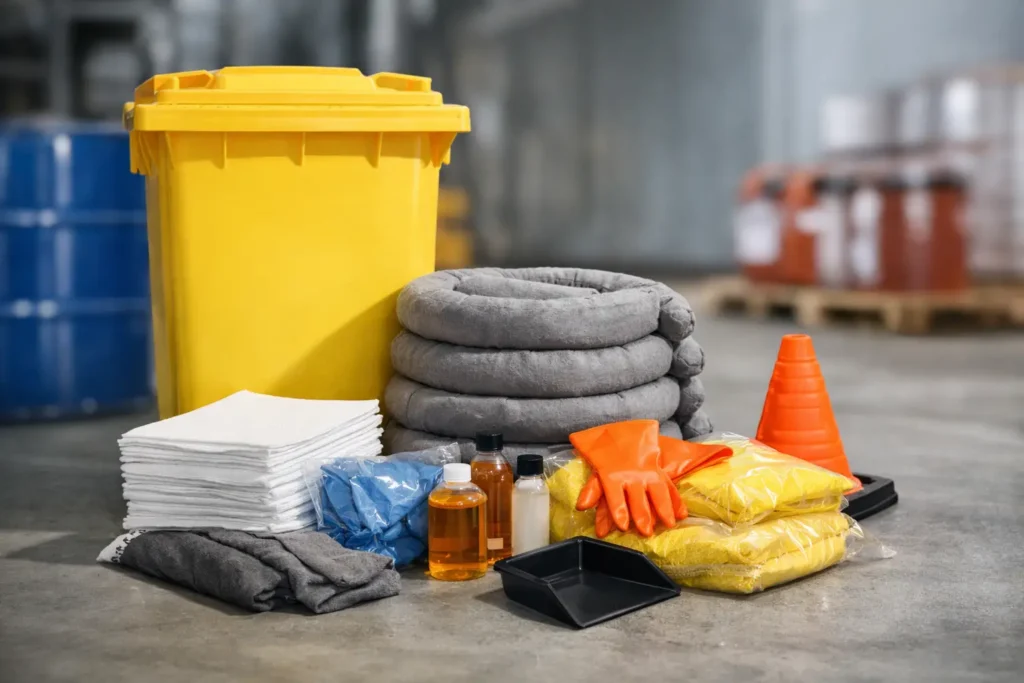
An effective 80L Hazchem Spill Kit should be ready to deploy, not a collection of loose products that staff need to interpret during an incident. Contents vary by supplier and kit configuration, so always check the included quantities before ordering. In practical terms, the kit should provide a way to contain the spill, absorb it, collect used materials, and protect the responder.
Chemical absorbent socks are usually the first items placed on the floor. Use them to build a barrier around the spill, protect drains, and slow the spread. Pads then lift pooled liquid from smooth surfaces, while loose absorbent can help manage irregular areas, cracks, and smaller remaining patches.
Disposal bags and ties are equally important. Once absorbents have contacted a hazardous chemical, they become contaminated waste and need to be handled according to the chemical involved and your local disposal requirements. Keep labels, waste containers, and site procedures aligned so used material does not become a second hazard.
Basic PPE may be included in some kits, but do not treat it as your complete chemical PPE program. Gloves, goggles, face protection, and protective clothing must match the chemical risk identified in your safety data sheet. Check kit PPE regularly for damage, missing items, and expiry where applicable.
Position the Kit Where the Spill Starts
A well-stocked kit is ineffective if it is locked in a distant storeroom. Place your 80L Hazchem kit near the chemical handling point, with a clear route to reach it. Good locations include beside chemical storage cabinets, near wash bays, in maintenance zones, and at loading areas where containers are received or moved.
Keep it visible and clearly marked. Do not stack cartons, spare parts, or pallets in front of it. In a busy depot, assign ownership to a supervisor or maintenance lead and include the kit location in staff inductions and shift handovers.
For vehicle-based operations, the decision may depend on the chemicals carried and the available storage space. An 80L kit may suit a larger service truck, mobile maintenance unit, or support vehicle. For smaller vans and utes, a compact vehicle kit plus an 80L kit at the depot can be a more practical combination.
Use the Kit in the Right Order
Fast response is about controlling spread before trying to absorb every drop. When it is safe to act, stop the source if possible by uprightening a container, closing a valve, or moving an undamaged container away from the leak. Do not attempt this if it exposes staff to splashes, fumes, or an unknown reaction.
Next, protect drains and create a perimeter with absorbent socks. Start at the lowest point or most likely exit path, then work back toward the spill. Once the liquid is contained, lay pads across the pooled area and use loose absorbent where pads cannot make good contact.
Collect saturated materials with suitable tools, place them in the supplied disposal bags or approved waste containers, and clean the area only after the bulk liquid has been removed. Report the incident, record what was used, and restock immediately. A kit that has absorbed 30L is no longer an 80L response resource.
Keep Refills Ready, Not on a Wish List
Minor leaks can quietly empty the most useful components from a kit. Pads disappear first, socks are used to protect drains, and disposal bags are often overlooked until the next incident. A quick monthly inspection prevents the common problem of opening a kit to find half the contents missing.
Check that the kit is accessible, dry, clearly labeled, and complete. Replace used or damaged absorbents, PPE, disposal bags, and instruction materials. If your site repeatedly uses the same components, keep those refills nearby rather than waiting for a full-kit replacement.
Spillkits.com.au helps sites select ready-to-deploy chemical, oil and fuel, and general-purpose spill response equipment for practical workplace use. Match the kit to the spill risk, position it where crews can reach it, and keep enough refills on hand to make the next response just as fast as the first.