
Blog
Fuel Station Spill Kit Requirements Explained
Aug
A small overflow at the bowser can become a much bigger problem when fuel reaches a stormwater grate, travels across the forecourt or creates a slip hazard near customers. Fuel station spill kit requirements are therefore not just about having a red bin somewhere on site. Your equipment needs to match the fuels handled, the likely spill volume, site layout and the speed at which staff can respond.
For Australian service stations, the right setup is practical: contain the spill, protect drains, recover the fuel safely and keep the forecourt operating where it is safe to do so. A ready-to-deploy kit also gives console operators, driveway attendants and maintenance teams clear equipment to use before a minor incident turns into an environmental release.
What fuel station spill kit requirements should cover
There is no single spill kit capacity that suits every fuel station. Requirements should be set through your site risk assessment, environmental procedures, dangerous goods controls and any conditions set by your state or local authority. The basic test is simple: can your team immediately control the most credible spill before it reaches a drain, soil, gutter or public area?
At a minimum, a fuel station spill response setup should address fuel dispensing areas, tanker delivery points, fill points, oil storage areas, workshops and any place where contaminated runoff could enter stormwater. It must also be easy to find, clearly marked, accessible when vehicles are on site and maintained after use.
For petrol, diesel, oils and many hydrocarbons, select oil and fuel absorbents. These are generally made from hydrophobic polypropylene, which repels water while taking up hydrocarbons. That matters when a spill occurs during rain or near a wet forecourt. General purpose absorbents can be useful for water-based liquids and mixed workshop mess, but they are not the first choice for a fuel spill on wet ground.
Chemical or Hazchem kits are different again. If your site stores chemicals such as cleaning agents, coolants, acids or alkalis, assess them separately against their safety data sheets. Do not assume an oil and fuel kit will safely handle every liquid held on site.
Size the kit around realistic spill scenarios
Start with the question your team should be able to answer: what is the largest spill we can reasonably expect our staff to contain without waiting for a specialist contractor?
A small unattended outlet may need a vehicle-sized response bag near the kiosk plus a larger central kit. A busy highway service centre with frequent tanker deliveries, multiple dispensing islands and a workshop needs a higher-capacity, multi-point setup. The volume printed on a kit is its total absorbency under test conditions, not a guarantee that every real-world spill will be simple to clean up. Uneven concrete, rainwater, wind and fast-moving fuel can increase the amount of absorbent required.
Use this practical guide when planning capacity:
| Area or activity | Typical response need | Practical kit approach |
|---|---|---|
| Passenger vehicle refuelling area | Drips, overfills and small hose leaks | 30L to 50L accessible kit with pads, socks and disposal bags |
| Diesel or high-flow truck lane | Larger overfills and broader spread | 50L to 80L kit with extra socks and drain protection |
| Tanker unloading and fill points | Coupling failure, hose leak or delivery overflow | 120L to 240L wheeled kit positioned nearby |
| Workshop, oil store or generator area | Oils, lubricants and maintenance fluids | Dedicated oil and fuel kit sized to stored volume and drainage risk (50L, 80L or 120L) |
A 30L bag fits well in a supervisor vehicle, behind a counter or near a compact pump island. It is useful for fast first response, but it is not enough as the only protection for a tanker delivery area. A 120L or 240L wheelie-bin style kit provides more pads, containment socks, PPE and waste bags for a larger release. Keep it close enough to reach quickly, but not so close to the highest risk point that a spill blocks access to it.
The contents that make a kit usable
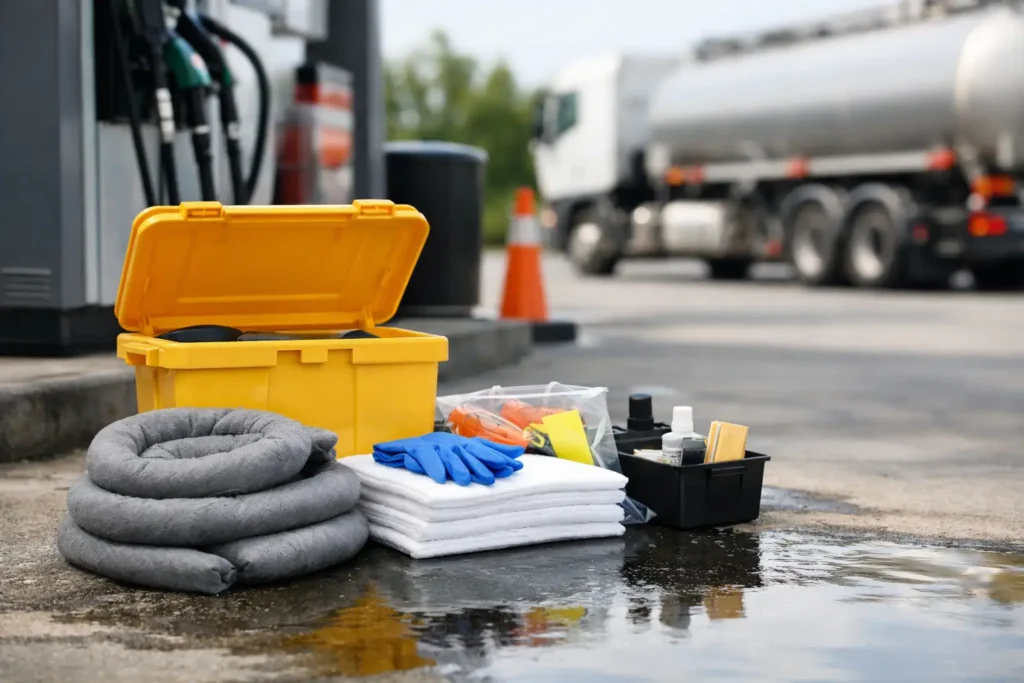
A spill kit is only effective if its contents perform distinct jobs. Absorbent pads recover pooled fuel and wipe down affected surfaces. Absorbent socks form a barrier around the spill, along kerbs or in front of drains. Loose absorbent can help with rough surfaces, though pads and socks are usually quicker to place and recover on a forecourt.
Your main fuel spill kit should include enough equipment to contain, collect and bag the expected release. For a complete response, check for these items:
- Oil and fuel absorbent pads for recovery and final clean-up.
- Absorbent socks or booms for perimeter control and drain protection.
- Heavy-duty disposal bags and ties for used absorbent.
- Gloves, goggles and other PPE suitable for the substances handled.
- A simple instruction card, hazard labels and a contents checklist.
Drain protection deserves its own planning. A sock placed in front of a grate can slow runoff, but it may not seal the drain. Keep a drain cover or drain mat where a spill could reach stormwater quickly. The right option depends on the grate size, surface condition and whether there is standing water. Staff should know where drains lead and which ones must be protected first.
Position kits for the first two minutes
The first two minutes of a spill response shape the outcome. If staff need to unlock a storeroom, walk through the shop or search for missing pads, fuel may already be moving towards a drain.
Place smaller kits at dispensing areas or in the kiosk where trained staff can access them immediately. Locate larger kits near tanker unloading points, workshop entrances and other higher-volume risks. Mark the location clearly. Keep the path clear of stock, parked equipment and bins.
Equipment placement must also suit site conditions. A kit at the far end of a large forecourt may technically be available but operationally too slow. Conversely, placing every item outdoors can expose bags and labels to UV, rain and damage. A weather-resistant cabinet or wheelie bin can protect supplies, provided it remains easy to open.
Give staff a clear response sequence
Frontline staff do not need a complicated manual to manage a small fuel spill, but they do need a consistent sequence. Train them to stop the source if it is safe, keep customers and ignition sources clear, protect nearby drains, contain the spread and apply absorbent from the outside inward.
For a larger release, strong fuel vapours, a spill entering drainage, or any situation staff cannot control safely, isolate the area and escalate under the site emergency plan. Call emergency services where required and follow your incident reporting and environmental notification procedures. Do not let staff attempt to wash fuel into a drain or hose it away. Water can spread contamination and turn a contained spill into a reportable release.
Make the instructions specific to the site. Identify emergency shut-offs, drainage paths, assembly points, emergency contacts and the location of additional equipment. A short laminated response card inside the kit is often more useful in the moment than a long procedure stored in an office folder.
Inspection, refills and disposal are part of the requirement
A spill kit that has been used once, raided for cleaning pads or left open in the weather is no longer a dependable emergency resource. Assign a person to inspect kits on a regular schedule and after every incident. Busy sites may need weekly visual checks, while lower-risk locations may use monthly documented checks. Your risk assessment should set the frequency.
During each check, confirm the kit is in place, accessible, labelled and stocked. Count pads and socks against the contents list. Replace damaged PPE, missing disposal bags and contaminated items immediately. Keep spare pads, socks and waste bags nearby so a minor clean-up does not leave the station underprepared until the next order arrives.
Used fuel absorbents are contaminated waste. Bag and label them appropriately, store them securely away from drains and ignition sources, then arrange disposal in line with local waste requirements and the material involved. Never put fuel-soaked absorbents in general rubbish unless your approved waste process specifically permits it.
Equip the site for the risks you actually have
The best fuel station setup is not the biggest kit on a catalogue page. It is the combination of accessible first-response bags, higher-capacity kits at delivery points, drain protection and refill stock that matches your daily operations. Review it after site changes, new equipment, increased truck traffic or a real spill event.
Keep the right absorbents where the first spill is likely to happen, and keep enough reserve capacity where the consequences are highest. That is how a spill kit becomes practical site protection rather than equipment collecting dust in the storeroom.