
Blog
Granules Versus Absorbent Socks: Which Fits?
Aug
A leaking 205L drum does not wait for a procurement meeting. When liquid starts tracking across a workshop floor, towards a stormwater drain or beneath stored stock, your first containment choice determines how far the incident spreads. In the decision between granules versus absorbent socks, the right answer depends on the liquid, the surface, the spill path and how quickly your crew must regain control.
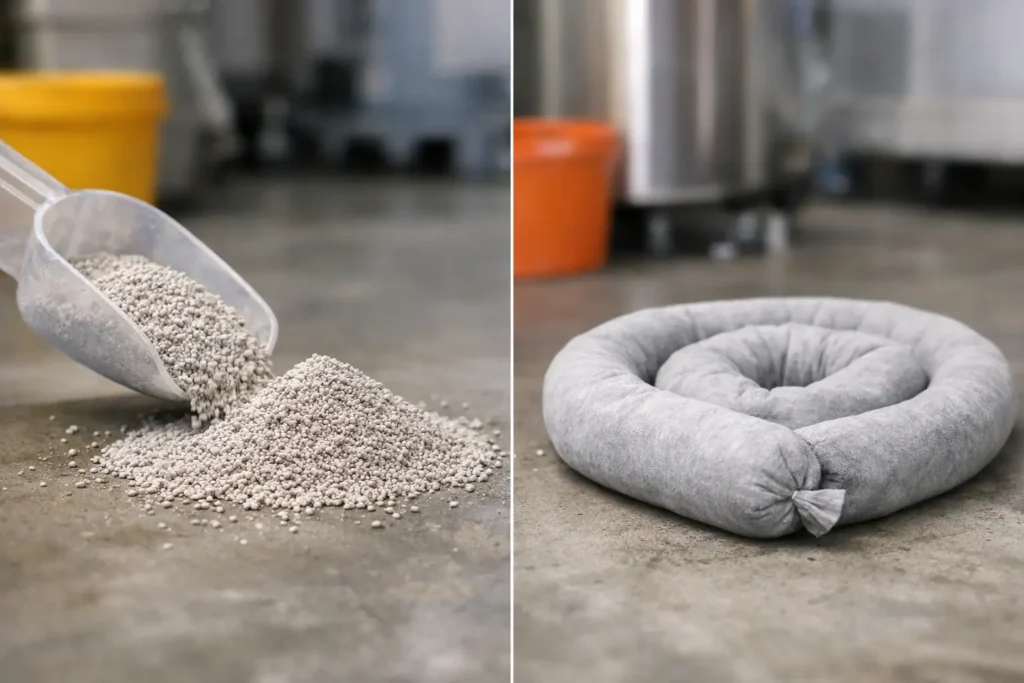
Granules can cover a broad surface spill and help improve footing. Absorbent socks create an immediate physical barrier that channels liquid away from drains, doorways and equipment. For most industrial sites, the strongest response is not choosing one product forever. It is keeping both in the right locations, with each product assigned to the task it performs best.
Granules versus absorbent socks: the operational difference
Absorbent granules are loose particulate media spread directly over a spill. They are commonly used on workshop floors, loading bays and rough outdoor surfaces where liquid has already pooled or spread widely. Depending on the product, granules may suit oils, fuels, coolants, water-based liquids and general workshop fluids. Always verify the product’s compatibility before deployment, particularly around hazardous chemicals.
Absorbent socks are flexible tubes filled with absorbent material, often polypropylene. Place them around a spill perimeter, along a doorway, beside a drain or across a known flow path. They stop liquid travelling further while your crew recovers the source and lays pads, rolls or granules inside the contained area.
The practical distinction is simple: granules absorb where the liquid sits; socks control where the liquid goes. A spill that reaches a drain can become an environmental incident, cleanup cost and reportable compliance problem. Put socks down first when there is any chance of migration.
| Requirement | Granules | Absorbent Socks |
|---|---|---|
| Best use | Soaking up pooled liquid | Containing and diverting liquid |
| Deployment | Spread over the spill | Place around the perimeter or flow path |
| Drain protection | Limited on their own | Strong first line of defence |
| Surface suitability | Excellent on uneven, dirty or rough floors | Best on floors, thresholds and around drains |
| Cleanup | Sweep or shovel into disposal container | Collect and dispose after use |
| Reuse | Generally single-use | Generally single-use |
Choose socks first when containment is the priority
A sock earns its place when the spill has somewhere to travel. Position it immediately downhill, around floor drains, across roller-door openings and beside kerbs. In a warehouse, that may mean isolating a forklift hydraulic leak before it reaches pedestrian areas. At a transport depot, it may mean stopping diesel from a damaged tank moving into the wash bay or stormwater system.
For oil and fuel spills, select hydrophobic polypropylene socks. These absorb hydrocarbons while repelling water, making them particularly useful around wet loading areas, drains and outdoor hardstands. Yellow chemical socks are generally used to signal chemical response and may suit a broader range of aggressive liquids, but compatibility must be confirmed against the substance involved.
Use socks as a rapid containment line in these situations:
- A leak is flowing toward a drain, doorway, pit or unsealed ground.
- A drum, IBC, vehicle or plant item is still leaking and cannot be isolated instantly.
- The spill is spreading under racking, machinery or stored materials.
- You need to divide a large spill into manageable recovery zones.
Socks are not designed to replace secondary containment. If drums, IBCs or decanting activities are regularly exposed to leaks, install correctly sized bunding before the next incident. Spill response equipment manages the unexpected. Bunds manage the predictable risk of stored liquids.
Use granules when the liquid has already spread
Granules work hard in workshops because they can be broadcast across irregular surfaces, around wheels, beneath machinery and over thin films of oil that pads may not fully contact. They can also help crews regain traction after a coolant, lubricant or diesel spill, reducing the immediate slip hazard while cleanup is underway.
They are especially useful for small to medium spills where the liquid is contained within a defined area and there is no active path to drainage. Apply enough material to cover the liquid completely, allow it to absorb, then sweep or shovel the saturated media into a suitable waste container. Do not sweep product into drains, wash it away with a hose or treat it as ordinary rubbish without checking the waste classification requirements for the absorbed substance.
Granules have limits. Wind can move them outdoors. They are slower to establish a boundary around fast-moving liquid, and loose material can be impractical around sensitive equipment, food production areas or clean manufacturing lines. For those environments, pads and socks often provide a cleaner, more controlled response.
Build a spill response sequence that works under pressure
The fastest crews do not debate product choice at the spill. They follow a set sequence: protect people, stop the source if safe, contain the spread, absorb the liquid, then dispose of used materials correctly.
Start by checking whether the liquid is known. If it is unidentified, corrosive, flammable or producing fumes, isolate the area and use the appropriate PPE and chemical-response equipment. Do not send staff in with general-purpose granules because they are close by. Chemical compatibility comes first.
Once the immediate hazard is controlled, lay socks around drains and the outer edge of the spill. For a small hydraulic oil leak, one or two socks may be enough to block the flow path. For a larger drum failure, create an outer perimeter first, then add inner socks to section the pool. Apply granules or pads within that perimeter to recover the liquid.
This combination reduces product consumption. Without a containment line, teams often keep throwing absorbents at an expanding spill. With socks holding the boundary, crews can calculate the affected area, deploy only what is needed and return the area to service sooner.
Match the absorbent to the liquid and the site
Do not stock one generic product and assume it covers every scenario. Oil and fuel absorbents, chemical absorbents and general-purpose absorbents serve different risks.
Oil and fuel products are suited to hydrocarbons such as diesel, petrol, lubricants and hydraulic oil. General-purpose absorbents handle common non-aggressive workshop liquids, including water, coolants and many maintenance fluids. Chemical or hazchem absorbents are selected for acids, alkalis and other hazardous substances, subject to compatibility guidance and site procedures.
Your site layout matters just as much as the liquid. A mechanic’s bay may need granules near service pits, oil-only socks by drains and pads beneath work areas. A civil contractor’s ute should carry a compact vehicle spill kit with socks and pads that deploy in seconds. A warehouse handling multiple drums requires visible, larger-capacity response points near receiving areas, decanting stations and chemical storage.
Keep drain covers close to high-risk drains. A sock slows and redirects liquid, but a drain cover provides a more direct seal when the drain itself is threatened. Equip both controls where a spill could reach stormwater.
Size your stock for credible spills, not minor drips
A depleted spill kit is not compliance equipment. It is an empty container that creates false confidence. Review your inventory after every use and size replenishment stock around the largest credible spill in each work zone.
A 20L vehicle kit may suit a service ute or small maintenance vehicle. It will not manage a failed 205L drum. For workshops, depots and warehouses, assess the containers handled, transfer points, drain locations and likely travel paths. If your crew stores or moves 205L drums, keep enough socks to protect drains and enough absorbent capacity to manage a substantial release until specialist support arrives.
For sites with bulk chemicals, flammables or IBCs, pair spill kits with bunding and fit-for-purpose storage controls. Keep used granules, pads and socks in compatible disposal bags or drums, clearly labelled pending disposal. The absorbed liquid determines the waste stream, not the original appearance of the absorbent.
Order the response gear your crew will actually use
Place socks where the first person on scene can reach them without crossing the spill. Keep granules with brooms, scoops and disposal bags in workshop response stations. Mark spill kit locations clearly, train crews on the difference between oil-only, general-purpose and chemical absorbents, and replace consumed components immediately.
For procurement teams, standardising core refill items across sites reduces delays and ordering mistakes. Specify sock type, diameter, length, absorbent category and required capacity. Request itemised GST on products and freight, use purchase orders where required, and keep a simple replenishment schedule for high-use facilities. Rapid nationwide dispatch supports urgent restocking, but stock on hand is what protects the site in the first minutes.
Select absorbent socks to stop the spread. Use granules to recover what is already on the ground. Equip the right response point now, before a routine leak becomes a drain contamination event or a costly shutdown.