
Blog
How Often to Inspect Spill Kits on Australian Sites
Aug
A spill kit that is missing absorbent pads, has a broken seal or contains the wrong media is not a spill response system. It is a delay at the exact moment your crew needs to contain fuel, oil, coolant or chemicals. If you are asking how often to inspect spill kits, the practical answer is simple: check them routinely, check them after every use, and increase the frequency wherever spill risk is higher.
For most workplaces, a documented monthly inspection is a sensible minimum operating standard. Busy workshops, transport depots, chemical stores and outdoor loading areas should add weekly visual checks. This is how you keep response equipment ready for deployment, protect drains and avoid discovering a depleted kit during an incident.
How often should you inspect spill kits?
Set the inspection frequency according to the kit location, the materials handled and the chance of unauthorised use. A sealed 20L vehicle spill kit in a supervisor’s ute does not face the same exposure as a 240L wheelie-bin kit beside a diesel bowser or chemical decanting station.
Use this schedule as an operational baseline:
| Site condition | Recommended check frequency | Why it matters |
|---|---|---|
| Low-risk office, store room or light-duty area | Monthly | Confirms stock remains sealed, accessible and in date. |
| Workshop, warehouse or fleet depot | Weekly visual check + monthly recorded inspection | High traffic and minor leaks can deplete stock without being reported. |
| Fuel, oil, chemical or hazardous goods area | Weekly recorded inspection | Higher consequence spills demand immediate containment capacity. |
| Vehicle and mobile plant kits | Pre-start or weekly, plus after each deployment | Mobile kits are moved, borrowed and exposed to weather and vibration. |
| After any spill response, training drill or opened kit | Immediately | Refill before the kit is returned to service. |
Your risk assessment, environmental management plan, client requirements, insurer and site procedures may require a tighter interval. Follow the strictest applicable requirement. The point is not to create paperwork for its own sake. It is to prove that the correct equipment was present, usable and available when your crew needed it.
Inspect after use – even a small spill
A common failure point is treating a minor oil drip as too small to trigger a refill. A few pads taken from a kit, one used drain cover or a partly used disposal bag can leave the next responder short. A spill kit is rated by the absorbent capacity available inside it, not by the size printed on the outer bin.
Inspect and replenish the kit immediately after use, including training exercises and false alarms where packaging has been opened. Record what was used and replace like for like. Oil-only absorbents are not a substitute for chemical absorbents, and general-purpose pads are not automatically suitable for every hazardous liquid.
For fleet operators, make the post-use check part of the driver handover or maintenance workflow. For fixed sites, assign it to a named role rather than leaving it to the next person who notices the empty shelf.
What to check during a spill kit inspection
A fast inspection should take only a few minutes. Start with access. The kit must be visible, clearly signed, unobstructed and close enough to the hazard to be deployed without crossing the spill. A wheelie bin locked behind pallet racking or a vehicle bag buried under tools will not protect your site.
Then check the container itself. Look for cracked bins, damaged wheels, missing lids, water ingress, UV damage and faded labels. Confirm that the spill kit type matches the materials in the area. Oil and fuel kits use hydrophobic polypropylene absorbents that repel water and float, making them suited to hydrocarbons around wash bays, drains and waterways. Chemical or hazchem kits are designed for a broader range of liquids, while general-purpose kits suit many non-aggressive workshop fluids.
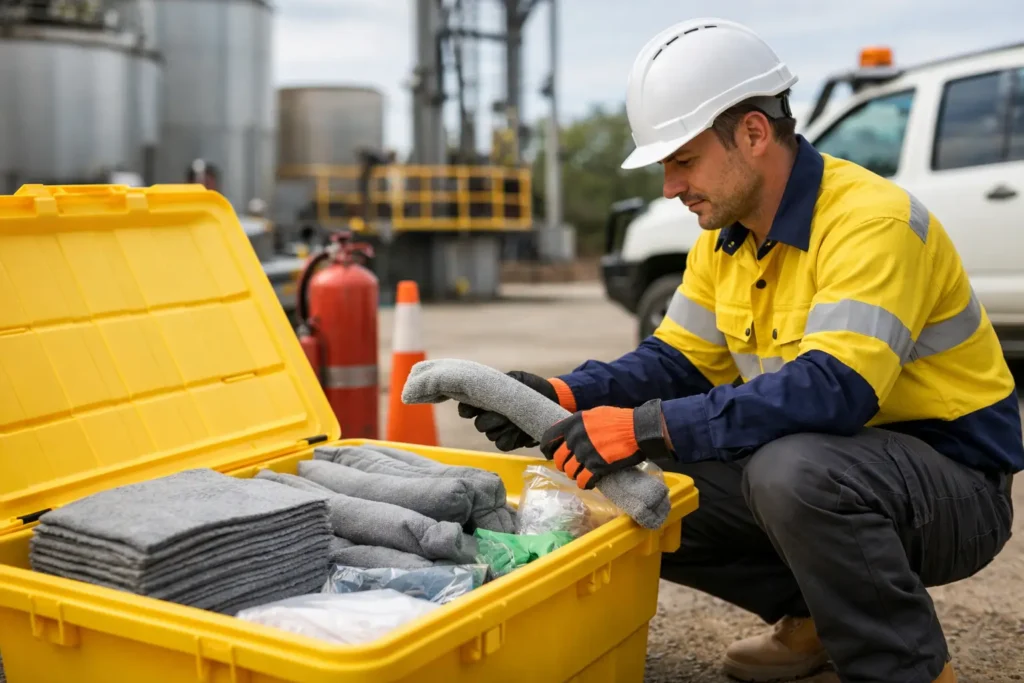
Check the contents against the kit inventory. Count absorbent pads, socks, pillows, granules where supplied, PPE, waste bags, ties and instruction materials. Make sure gloves are intact and correctly sized for the task, and that goggles, coveralls or other supplied PPE have not perished. If the kit includes drain protection, inspect it for tears, distortion and contamination that could prevent a proper seal.
Pay particular attention to these readiness failures:
- Absorbents removed for everyday housekeeping and never replaced.
- Mixed or unidentified media placed back in the kit after a response.
- Disposal bags, labels or ties missing, leaving no safe way to package contaminated waste.
- PPE degraded by heat, sunlight or chemical exposure.
- A kit positioned beside a new hazard, but stocked for the old one.
Finish by checking the inspection tag or register. Note the date, inspector, condition, stock replaced and any corrective action. A simple record creates accountability and gives procurement teams a clear trigger to order refills before stock reaches a critical level.
Match the inspection to spill risk and kit size
Capacity matters. A 20L vehicle bag can handle a small leak at a roadside breakdown or service call, but it will not contain a ruptured drum or a major diesel release. A 120L or 240L site kit provides more absorbent capacity and equipment for workshops, warehouses and loading zones, yet it still needs the right placement and supporting controls.
Where 205L drums, IBCs or bulk fuels are stored, do not rely on spill kits alone. Inspect secondary containment at the same time. Check bunds and pallets for cracks, chemical attack, accumulated rainwater, blocked drains and lost capacity. A bund that is already half full of water cannot provide its stated containment volume when a drum fails.
This is also the moment to inspect drain covers, absorbent socks and portable containment. Protecting the nearest stormwater inlet can be the difference between an on-site clean-up and an environmental release. Select equipment based on the credible spill volume, not the best-case scenario.
Who should own the inspection process?
Assign an owner for every kit location. In a small workshop, that may be the manager or leading hand. At a larger facility, area supervisors can inspect local kits while the HSEQ team audits records and manages replenishment. Fleet managers should include vehicle kits in vehicle inspection sheets.
Avoid a system where everyone is responsible. That usually means nobody is accountable when pads disappear. Give the owner authority to quarantine damaged kits, raise a purchase order and restock immediately. Procurement teams should keep approved refill lines and replacement kits available, so a corrective action does not wait for a lengthy sourcing process.
Spillkits.com.au supports fast commercial ordering with purchase order acceptance, itemised GST for products and freight, and rapid nationwide dispatch. Keep a repeatable reorder list for each location: the correct absorbent type, the kit capacity, drain protection and waste-disposal components. That reduces ordering errors when stock needs replacing quickly.
Build inspections into normal site routines
The best inspection schedule is one your team actually completes. Add fixed-site kit checks to weekly safety walks, warehouse opening checks or environmental inspections. Add mobile kit checks to pre-starts, vehicle servicing and driver handovers. Use a register that identifies the kit number, location, capacity and media type so crews cannot accidentally refill a chemical kit with oil-only products.
Training should cover where kits are, who calls for support, how to stop the source where safe, how to protect drains and how to segregate contaminated waste. Do not ask untrained workers to identify unknown chemicals or clean up a spill beyond their capability. Escalate where required and follow your emergency response procedure.
A monthly tick on a register is useful, but a stocked, correctly placed kit is what protects the operation. Inspect before stock runs low, replenish after every deployment and upgrade the kit where the credible spill has outgrown your current capacity. Equip the site now, rather than explaining an empty spill kit after the fact.