
Blog
How to Choose Spill Bunds for Industrial Sites
Sep
A leaking drum can turn a clear workshop floor, loading bay or chemical store into an environmental incident within minutes. Spill bunds give your site a controlled place for drums, IBCs and containers to sit, so leaks are captured before they reach drains, soil, traffic areas or neighbouring stock. Select the right capacity now and keep your operation moving when a container fails.
For warehouse managers, depot crews, procurement teams and government facilities, bunding is not an optional add-on. It is the practical secondary containment layer that supports safe storage, cleaner audits and faster spill response. The right unit protects the floor, preserves access around stored liquids and reduces the likelihood of costly clean-up downtime.
What spill bunds do on site
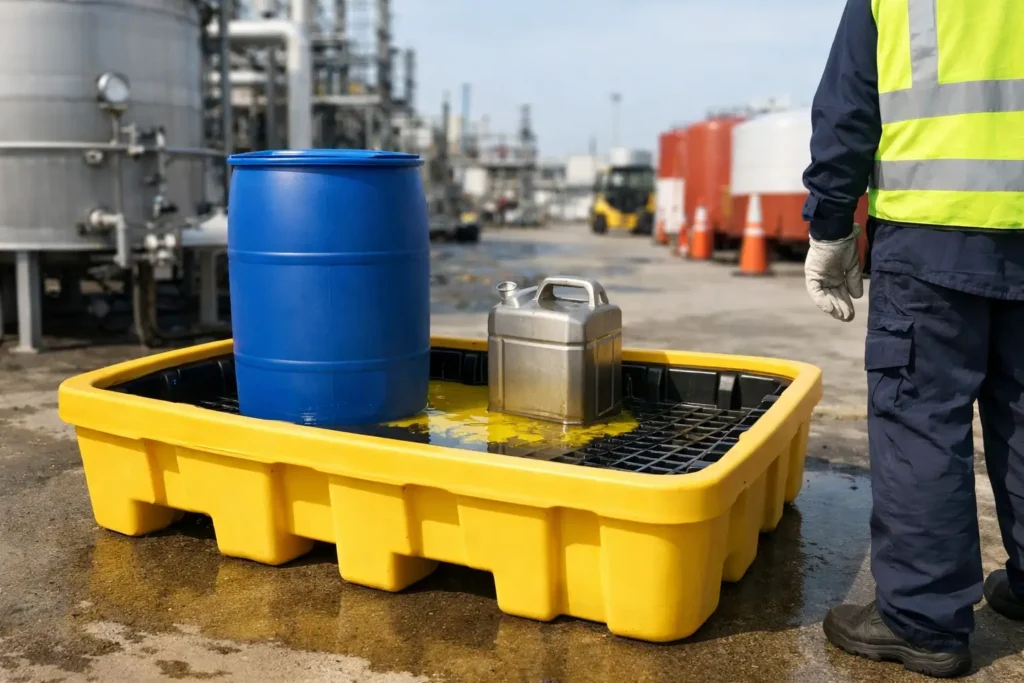
A spill bund is a purpose-built containment tray, pallet or barrier system positioned underneath liquid storage. Its job is simple: retain the contents of a leaking package until your team can isolate the source, deploy absorbents and arrange safe recovery or disposal.
That containment matters most where oils, fuels, coolants, solvents, chemicals, paints and other liquids are stored in 20L drums, 205L drums, jerry cans or IBCs. A drum may look sound during a daily walk-through, then split at a seam after a forklift knock, handling damage or long-term corrosion. Without a bund, the liquid spreads under racking, through doorways and towards drains. With one, the incident stays contained at the source.
Bunding also makes routine housekeeping easier. Decanting, pumping and dispensing are messy tasks, particularly in maintenance workshops and fleet depots. Place the activity over adequate containment and minor drips are managed before they become a slip hazard or a reportable event.
Size spill bunds before you order
The fastest way to buy the wrong bund is to count containers but ignore their volume. Start with what will actually sit on the unit, including the largest container, whether it is a 205L drum or a 1,000L IBC. Then allow for the containment capacity required by your site procedures, dangerous goods assessment, environmental obligations and applicable state or territory requirements.
A common secondary-containment benchmark is capacity for at least 110 per cent of the largest stored container or 25 per cent of the total stored volume, whichever is greater. This is a useful procurement starting point, not a substitute for checking the requirements that apply to your specific substance, storage arrangement and jurisdiction. Incompatible chemicals, rain exposure, fire risk and drain proximity can all require a different approach.
Use this practical sizing check before adding items to a purchase order:
- Count every container stored on the bund at one time, not just the drums currently in use.
- Record the capacity of the largest individual container and the total liquid volume.
- Confirm the bund’s listed sump capacity, load rating and usable deck area.
- Allow room for safe drum handling, dispensing equipment and pallet jack or forklift access.
A two-drum bund might be right for a small maintenance bay holding fresh oil and waste oil separately. It is not automatically suitable for four drums because they can physically fit on top. Overloading a bund reduces safe access, may exceed its load rating and can leave you short of the containment volume your site needs.
Drum pallets, IBC bunds and collapsible options
Fixed polyethylene drum bunds are the everyday choice for workshops, warehouses and stores. They provide corrosion-resistant containment for many common industrial liquids and can include removable grates that keep drums above collected fluid. This helps operators identify leaks early and makes recovery more manageable.
IBC bunds are built for the footprint and weight of 1,000L intermediate bulk containers. They are the sensible choice for bulk diesel, lubricants, chemicals, additives and waste liquids where an IBC is permanently or regularly stored. Do not place an IBC on a standard drum pallet unless its load rating, dimensions and sump capacity explicitly support it.
Collapsible bunds suit mobile operations where liquid handling happens temporarily. Civil contractors, field service teams, transport operators and emergency response crews can deploy them for refuelling, plant maintenance or temporary chemical transfer, then pack them down when the task is complete. The trade-off is that they need a clean, level surface and careful placement away from sharp objects and vehicle traffic.
Match the bund material to the liquid and environment
Polyethylene bunding is popular because it resists rust and suits a wide range of oils, fuels and chemicals. Yet material compatibility is never something to assume. Check the safety data sheet for the stored substance and verify that the bund material will tolerate it, especially for aggressive chemicals, oxidisers or long-term storage.
Think beyond the fluid as well. Outdoor bunding may collect rainwater, which reduces available sump capacity and creates another disposal question. Covered storage, appropriate weather protection and regular inspections keep the bund ready for the spill it was purchased to contain. Never pump contaminated liquid or rainwater from a bund into a stormwater drain.
For corrosive liquids, use dedicated containment and avoid combining incompatible products simply because there is room on the pallet. Segregation is as important as capacity. A large bund containing the wrong mix of chemicals can create a more serious reaction risk than separate, correctly selected units.
Build containment around the work, not just the storage rack
Storage bunding is only one part of site control. Identify every point where liquid can escape: drum decanting stations, waste-oil collection points, battery rooms, wash bays, generator refuelling areas and loading docks. Then position containment where the work occurs.
A workshop may need a four-drum pallet in the chemical store, a low-profile bund beneath the waste-oil tank and a portable collapsible bund for mobile plant servicing. A transport depot may need IBC containment at the bulk-fluid area plus a ready-to-deploy drain cover near the wash bay. This layered approach prevents a minor failure in one area from becoming a site-wide response.
Keep compatible absorbents nearby. Oil and fuel absorbents use hydrophobic media that repels water and targets hydrocarbons, making them useful around workshops, marinas and outdoor fuel areas. Chemical absorbents are selected for broader hazardous-liquid response, while general-purpose absorbents suit non-aggressive oils, coolants and water-based liquids. The bund contains the release; the correct absorbent helps your team recover it quickly.
Do not ignore handling and access
A bund that blocks a forklift path, prevents drum inspection or makes dispensing awkward will be bypassed under pressure. Measure the location before ordering. Check door widths, rack clearances, turning space and the access needed to replace a full drum safely.
For frequently handled drums, choose a configuration that supports your handling method. Some sites need a low-profile design for drum trolleys, while others need a pallet-style bund that can be moved by forklift when empty. Review the loaded weight as well as the liquid capacity. Four 205L steel drums can weigh well over a tonne once full.
Place bunds on stable, level ground and inspect grates, walls and sumps routinely. Remove accumulated debris, investigate any liquid found in the sump and replace damaged units promptly. A cracked or overloaded containment pallet is not a compliance control.
Make purchasing simple for busy sites
Order bunding as part of a complete spill-control plan, not as a stand-alone line item. Pair each storage area with suitable absorbents, drain protection, waste bags and a spill kit sized for the realistic release volume. A 20L vehicle bag is useful behind a driver’s seat for minor leaks; it will not manage a failed 205L drum in a warehouse. Match response capacity to the exposure.
For multi-site operators, standardise your bund sizes where practical. It simplifies replenishment, site inspections and procurement while giving crews familiar equipment wherever they work. Keep a register of what is stored on each bund, its containment capacity and the inspection date.
Spillkits.com.au supports commercial and government purchasing with purchase order acceptance, itemised GST for products and freight, and rapid nationwide dispatch. Specify the container count, largest vessel volume, liquid type and storage location when raising your order. That gives your team a clear path to the right containment without delaying a shutdown, audit or delivery schedule.
Secure the bund before the next drum arrives. A correctly sized containment unit is a straightforward investment in cleaner floors, protected drains and a site that is ready to respond when the seal, valve or drum wall finally gives way.