
Blog
How to Choose a Spill Kit for Work Vehicles
Aug
A leaking jerry can, split hydraulic hose or cracked oil filter can turn a normal run into a safety issue fast. A spill kit for work vehicles gives drivers and crews the equipment to contain and clean up common fluid spills before they spread across a depot floor, roadside shoulder, customer site or stormwater drain.
For fleet managers, workshop owners and site supervisors, the practical question is not whether a vehicle needs spill equipment. It is whether the kit matches the liquids carried, the likely spill size and the available storage space. Select the wrong kit and it may be too small, unsuitable for the substance, or empty when it is needed most.
Match the spill kit to the vehicle’s risk
Start with what each vehicle carries, uses or services. A diesel delivery ute has a different spill profile from a maintenance van transporting cleaning chemicals, while a field-service truck with hydraulic plant has different priorities again.
The three main kit types are straightforward:
| Kit type | Best for | Typical vehicle use |
|---|---|---|
| Oil & Fuel | Diesel, petrol, engine oil, hydraulic oil and other hydrocarbons | Utes, trucks, plant service vehicles and fuel-related work |
| Chemical / Hazchem | Acids, alkalis, coolants, solvents and unknown liquid chemicals | Cleaning, maintenance, laboratory and chemical service vehicles |
| General Purpose | Water-based fluids, coolants, lubricants and mixed non-aggressive workshop spills | Trade vans, facilities vehicles and general maintenance fleets |
Oil and Fuel kits use hydrophobic polypropylene absorbents. They absorb hydrocarbons while repelling water, making them a practical choice where a leak could reach a wet surface, puddle or drain. They are not the right answer for acids or caustic chemicals.
Chemical/Hazchem kits are designed for a broader range of hazardous liquids. Their absorbents are commonly colour-coded for quick recognition and should be selected where the vehicle transports corrosives, solvents or substances that are not suitable for standard grey oil absorbents. If drivers may encounter more than one chemical, check the safety data sheets and choose equipment compatible with the actual products carried.
General Purpose kits suit everyday non-hazardous maintenance spills, but they are not a substitute for a dedicated oil and fuel kit where diesel, petrol or hydraulic fluid is the main risk. When in doubt, choose based on the highest-consequence liquid the crew routinely handles, not the most frequent minor drip.
Size a spill kit for work vehicles properly
Vehicle spill kits are commonly measured by their total absorbency capacity in litres. That figure is useful, but it should not be treated as a promise that a kit can manage a spill of exactly that volume. Absorbency varies by liquid type, surface conditions and how much material is needed to build a containment barrier before cleanup begins.
For most cars, utes and trade vans, a compact 20L to 30L kit is a sensible minimum for dealing with drips, small leaks and a minor container failure. It fits behind the driver’s seat, in a side locker or in the tool compartment without taking over valuable load space.
A 40L to 50L kit gives maintenance vans and higher-use service vehicles more breathing room. It suits crews carrying oils, lubricants, filters, small chemical containers or portable equipment that can leak in transit. For trucks, plant service vehicles and remote work crews, 60L or more may be justified, particularly where replacement stock is not close at hand.
Use this practical sizing check before ordering:
- Estimate the largest realistic leak, not just the smallest likely drip.
- Allow enough socks or booms to surround the spill before pads are used.
- Factor in porous ground, uneven surfaces and wind, which can increase material use.
- Consider whether the vehicle works far from the depot, where a second kit or higher capacity is worthwhile.
A 20L kit is not designed to clean up a failed 20L drum. The crew will use absorbents for containment, saturated material, wiping and final cleanup. If the vehicle carries drums, multiple jerry cans or equipment with significant hydraulic oil capacity, step up the kit size and carry extra absorbents.
Choose a storage format crews will actually use
The best kit is the one that remains visible, protected and accessible. For work vehicles, bags are often the most practical format. They are compact, easy to move between vehicles and can be stored in a cab, toolbox or side compartment. A soft bag also reduces rattling and works well where space is tight.
Hard cases provide better protection from weather, dust and rough treatment. They suit external lockers, open-tray utes and vehicles travelling on unsealed roads. The trade-off is bulk. Make sure the case can be opened fully in its storage position and is not buried beneath tools, straps or stock.
For larger trucks and mobile workshops, a wheelie-bin-style kit or drum-based kit may be suitable, especially when the vehicle is effectively a mobile worksite. These provide higher absorbency and more room for disposal bags, but need secure mounting so they do not shift during transport.
Place the kit where the driver can reach it without unloading the vehicle. A spill does not wait for a toolbox reshuffle. Mark the storage position during induction and make it part of the vehicle handover process.
Check what is inside before you buy
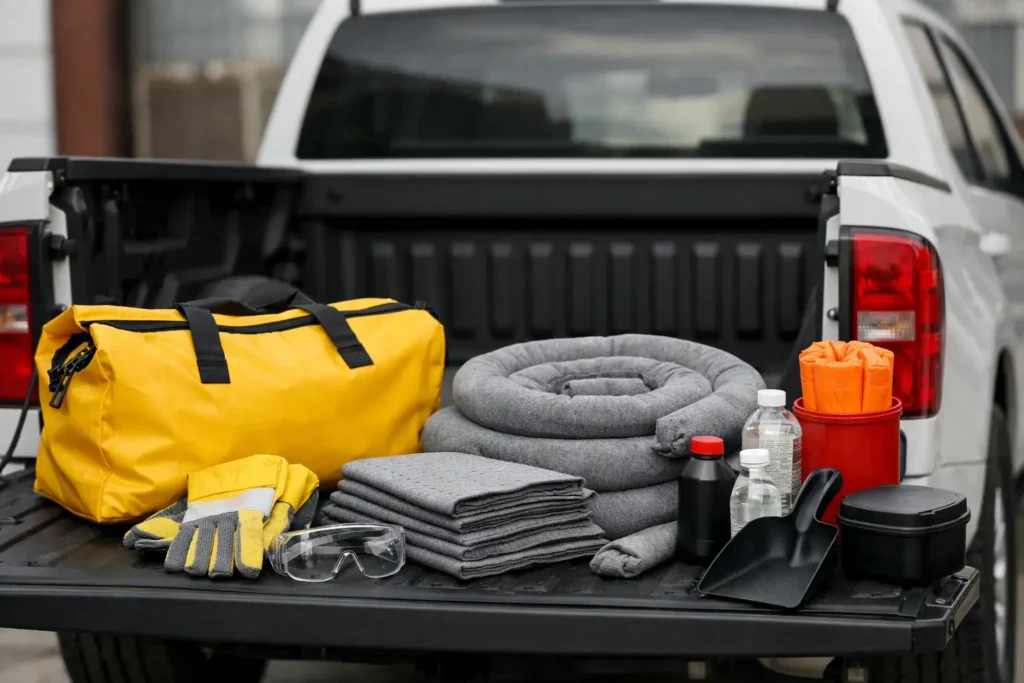
A useful vehicle kit needs more than absorbent pads. Pads collect liquid, but socks or booms stop it travelling. Disposal bags help crews secure contaminated waste, while gloves and protective eyewear support a safer response. A clear instruction sheet is valuable for drivers who do not deal with spills every day.
A practical vehicle spill kit should include enough components to contain, recover and package a small incident. Look for absorbent pads, absorbent socks or mini booms, PPE, disposal bags and a temporary seal or plug where relevant. For chemical risks, ensure the PPE and absorbents are suitable for the substances involved.
Drain protection deserves special attention. A spill that enters a stormwater drain can become an expensive environmental and operational problem. If crews regularly work in car parks, loading docks, fuel areas or workshop yards, keep a drain cover with the vehicle or at the job location. Use it early, before pads are laid down, if there is a clear risk of liquid reaching the drain.
Give drivers a simple response sequence
Equipment only works when crews know the first moves. Keep instructions simple and focused on immediate control. The response should be: stop the source if it is safe, protect people, stop the spill reaching drains or water, contain it with socks, absorb it with pads, then bag the used material for disposal according to site procedures and the substance involved.
Drivers should not attempt to manage a spill beyond their training, available PPE or equipment capacity. Escalate immediately where there is fire risk, strong fumes, a large volume, an unknown chemical, an injury or a spill entering a waterway or drain. The kit is for prompt first response, not a reason to take unnecessary risks.
Run a five-minute vehicle kit check at regular intervals. Confirm the kit is present, dry and accessible; inspect bags and cases for damage; check gloves and disposal bags; and replace used or missing components straight away. This is particularly important after servicing, staff changes or a vehicle swap, when kits can be moved or forgotten.
Keep refills ready at the depot
One small spill can use most of a compact kit, especially if the crew needs several pads and socks to prevent spread. Do not wait until the next scheduled stocktake to replace contents. A vehicle returned with a used kit should be restocked before it goes back on the road.
Keeping pads, socks, disposal bags and PPE in a designated depot refill point makes this easy. It also avoids replacing an entire kit when only a few components have been used. For larger fleets, set a minimum stock level based on the number of vehicles, likely spill frequency and delivery lead times to regional locations.
Assign responsibility clearly. A driver can report use, but a supervisor, workshop lead or depot storeperson should own the restock check. Record what was used and why. Over time, that information shows whether the fleet needs more capacity, a different kit type or better containment practices around recurring leaks.
Equip your fleet before the next leak
A well-chosen vehicle kit is a small piece of equipment with a big operational job. It protects drivers, keeps work moving and helps prevent a manageable leak becoming a contaminated work area or a missed delivery window.
Select the kit around the fluid risk, give it enough capacity for the vehicle’s real work, and keep refills within reach. When every driver knows where the kit is and what to do first, the response starts in seconds rather than after a call back to the depot.