
Blog
What Is in a Hazchem Spill Kit? Site Checklist
Aug
A leaking drum, split IBC valve or overturned chemical container can turn a normal shift into a shutdown quickly. Knowing what is in a Hazchem spill kit means your crew can contain the release, protect themselves and keep chemicals out of drains before the spill spreads.
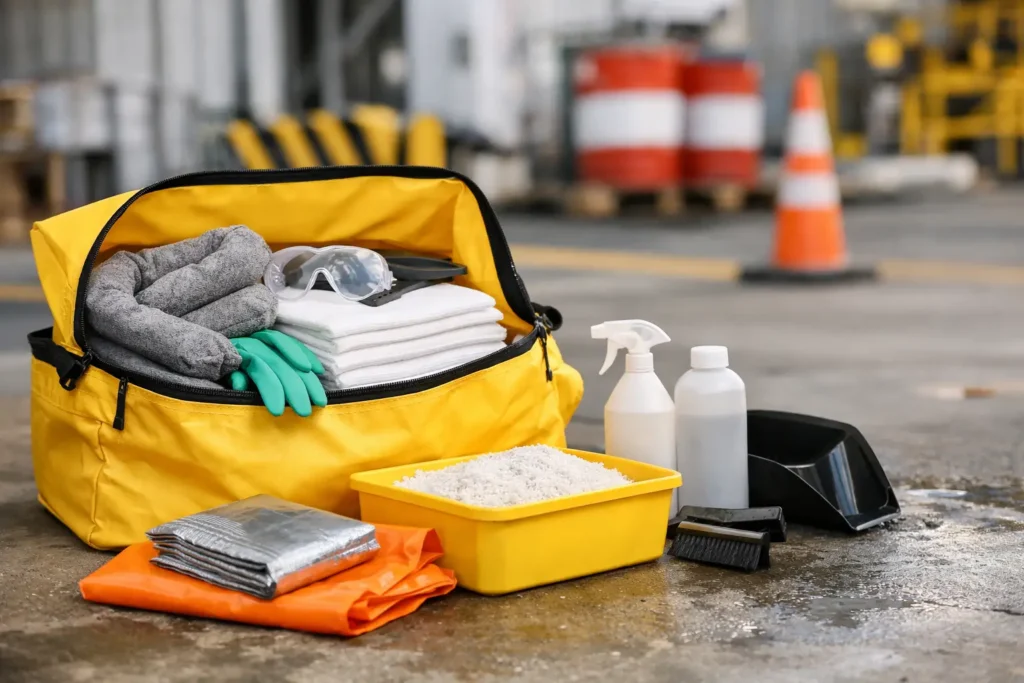
Hazchem kits are designed for hazardous liquid spills, particularly chemicals that may be corrosive, toxic or otherwise unsuitable for a standard oil and fuel kit. They usually contain highly visible absorbents, personal protective equipment and disposal materials in one ready-to-deploy container. The exact contents and capacity vary, but every item has a job to do in the first minutes of a spill.
What is in a Hazchem spill kit?
A properly stocked Hazchem kit combines four response functions: personal protection, containment, absorption and disposal. In practical terms, it gives staff the equipment to stop walking through the spill, prevent it reaching a drain, soak it up and package the contaminated waste for disposal.
Most ready-to-use Chemical/Hazchem spill kits include the following core components.
Chemical absorbent pads
Chemical absorbent pads are the workhorse of the kit. They are commonly made from polypropylene and are used to cover and absorb pooled liquid once the spill has been contained. Hazchem pads are often yellow so they are easy to identify on site and clearly separate from white oil-only absorbents.
Unlike hydrophobic oil and fuel absorbents, chemical pads are intended to take up a broad range of liquids, including water-based chemicals. That makes them useful in laboratories, warehouses, maintenance areas and chemical stores where the spill may not float on water.
Pads suit flat surfaces and small puddles. For a large release, use socks first to stop the spread, then lay pads from the outside edge towards the centre. This reduces the chance of pushing liquid further across the floor.
Absorbent socks and booms
Socks are flexible tubes filled with absorbent material. Place them around the spill perimeter, across doorways or in front of drains to form a barrier. They are fast to position around awkward shapes such as pallets, machinery feet and drum storage areas.
Larger Hazchem kits may include booms as well as socks. Booms provide a longer containment line for bigger incidents, loading bays or outdoor hardstands. They are not a substitute for drain protection where there is a direct risk of chemical entering stormwater, but they give the crew valuable time to control the flow.
Loose absorbent or granules
Many kits include loose particulate absorbent, sometimes called granules or absorbent powder. This material is particularly useful on uneven concrete, around cracked surfaces and where liquid has collected in small depressions that pads cannot reach.
Granules can be effective, but they create more waste and take longer to sweep up than pads. Use them where they add value rather than automatically tipping them over every spill. A brush and pan or shovel is normally included so the saturated material can be collected without staff handling it directly.
PPE for the first responder
A Hazchem kit should contain basic personal protective equipment. Common inclusions are chemical-resistant gloves, safety goggles, disposable coveralls and a face mask or face shield, depending on kit type.
PPE in a spill kit provides initial protection only. Your safety data sheet, chemical label and site procedure determine the right level of protection for the substance involved. For example, gloves that are suitable for a mild detergent may not be suitable for a strong solvent, acid or caustic product.
Do not send a worker into a vapour-heavy area simply because the kit contains a mask. If fumes are strong, the product is unknown, the chemical is reacting, or there is a fire risk, isolate the area and escalate to trained emergency responders. A spill kit helps with manageable releases – it does not make every chemical spill safe to clean up.
Drain cover or drain protection
Drain protection can be one of the most valuable items in a Hazchem response. A flexible drain cover, mat or seal is placed over a drain to prevent liquid entering stormwater or sewer lines. It should be deployed early, ideally before the spill reaches the drain.
For workshops, wash bays, loading docks and outdoor storage areas, keep dedicated drain protection close to the likely spill point rather than locked in a distant cupboard. A drain cover is most effective when the surface is reasonably clean and flat, so crews should practise placing it before an emergency.
Disposal bags, ties and labels
Everything used in the cleanup becomes contaminated waste. Hazchem kits typically include heavy-duty disposal bags, cable ties and labels so used pads, socks, granules and disposable PPE can be sealed and identified.
Never put contaminated absorbents in general rubbish unless your waste contractor and the relevant chemical requirements specifically allow it. The waste classification depends on what was spilled. Keep the product label or safety data sheet available for the person arranging disposal.
Tools and instructions
A basic Hazchem kit generally includes a scoop, scraper, brush and pan for collecting used absorbent. Some larger kits include additional tools, signage or barrier tape to help isolate the area.
Clear response instructions are also useful, especially for mixed teams, new starters and drivers. The best instructions are short: assess the hazard, wear suitable PPE, protect drains, contain the spill, absorb it, collect waste, report the incident and replace used stock.
Hazchem kits are not all the same
The word Hazchem can suggest one kit suits every hazardous substance. It does not. A general chemical spill kit is built for broad chemical response, but chemical compatibility still matters.
Check the product’s safety data sheet before selecting a kit for a known chemical. Strong oxidisers, highly reactive substances, hydrofluoric acid, mercury and other specialist hazards may require dedicated procedures, neutralisers or response equipment. For these products, a standard kit may be only one part of the site’s emergency plan.
It also matters whether the spill is oil, fuel or chemical. White oil-only absorbents repel water and are a strong choice for hydrocarbons around vehicle yards, marine areas and wet ground. Yellow chemical absorbents are better for many water-based liquids and unknown chemical spills. General purpose grey absorbents work across common non-aggressive workshop liquids, but should not be assumed suitable for corrosive or dangerous goods.
Select the right kit capacity
Kit size should match the credible spill, not the amount of shelf space available. Consider the largest container that could leak, the number of containers handled at once, and whether a spill could travel to a drain or neighbouring work area.
| Work area or task | Practical starting point |
|---|---|
| Service ute, delivery van or small mobile crew | 20L to 30L bag or compact vehicle kit |
| Forklift, workshop bay or small chemical cabinet | 50L to 80L kit |
| Warehouse, loading dock or drum store | 120L to 240L wheeled kit |
| Bulk chemical handling or multiple IBCs | Site-specific capacity, plus fixed drain protection |
A 20L kit behind the driver’s seat is useful for a small leak during transport, but it is not enough protection for a workshop that stores 205L drums. Likewise, a 240L wheelie-bin kit gives strong site coverage but is too bulky to rely on as the only response option for a fleet vehicle. Equip both the vehicle and the depot where the risk justifies it.
When calculating capacity, allow for cleanup rather than containment alone. A 20-litre spill can use more than 20 litres of absorbent once socks, pads, contaminated PPE and uneven surfaces are taken into account. For repeated handling of drums or chemicals near drains, sizing up is usually the safer operational decision.
Set the kit up for fast deployment
A sealed kit at the back of a crowded store is not ready for use. Position it where a person can reach it within seconds, with a clear path and visible signage. Keep chemical kits near chemical storage, decanting points, battery charging areas, wash bays and loading zones as appropriate.
Make the contents familiar before an incident. During a toolbox talk, show workers the difference between pads, socks and granules; demonstrate where the drains are; and explain who must be notified after a spill. This takes little time and prevents hesitation when a container fails.
Inspect the kit monthly and after every use. Replace used pads and socks immediately, check gloves have not degraded, ensure disposal bags are present, and make sure the container still closes properly. A partially used kit is one of the most common readiness gaps on busy sites.
Keep refills ready, not just the container
Minor spills often empty the most useful components first: pads, socks, gloves and waste bags. Replacing only the visibly used item can leave the kit unbalanced, especially if a small incident used most of the containment socks.
Keep a simple refill record and nominate one person to check stock. For higher-risk areas, hold spare chemical pads and socks beside the kit so the response capacity can be restored on the same day. Spillkits.com.au supports this practical approach with ready-to-deploy kits and refill components for vehicles, workshops and larger sites.
The right Hazchem kit is the one your team can identify, reach and use immediately. Put it close to the risk, size it for the credible spill, and replace every used component before the next shift needs it.