
Blog
PPE for Spill Response Team: What to Wear
Aug
A leaking drum, split hose or overturned container can turn a normal shift into a hazardous clean-up within minutes. Choosing PPE for a spill response team means matching protection to the substance, the likely exposure and the work required – before anyone reaches for an absorbent pad. The wrong gloves, footwear or eye protection can leave a responder exposed even when the spill kit itself is the right size.
For workshops, depots, warehouses, civil sites and transport fleets, the goal is simple: keep suitable PPE beside the spill equipment, make it easy to identify, and replace used items immediately. Staff should not need to search a storeroom while liquid is moving towards a drain.
PPE for a spill response team starts with the liquid
Do not select PPE based only on the appearance of a spill. Clear liquids may be corrosive, fuel can give off harmful vapours, and used oil may contain contaminants from the equipment it came from. Check the product label and Safety Data Sheet (SDS) before response where it is safe to do so. The SDS identifies the chemical hazards, recommended gloves, eye and face protection, respiratory requirements and first-aid measures.
A practical first question is whether the spill can be handled by on-site staff at all. A small diesel leak on a hardstand is very different from an unknown chemical release, a fuming substance, a spill in a confined space or a large release entering a stormwater drain. If the substance is unknown, highly hazardous, generating vapour, or beyond the capacity of your team and equipment, isolate the area and escalate to emergency services or a specialist responder.
PPE is the last line of defence, not permission to work too close to a hazard. Stop the source where safe, keep people out of the area, protect nearby drains and contain the liquid before starting clean-up.
Match PPE to the spill response task
A responder dealing with a small oil leak may only need suitable gloves, safety glasses, protective workwear and enclosed safety boots. Decanting leaking acid containers or handling contaminated absorbents can require a higher level of chemical-resistant clothing, splash goggles, a face shield and footwear with chemical resistance. The task matters as much as the liquid.
Use this quick guide as a starting point, then confirm against the SDS and your site risk assessment.
| Spill scenario | Typical PPE considerations | Key watch-out |
|---|---|---|
| Oil, diesel or hydraulic fluid on a workshop floor | Nitrile gloves, safety glasses, coveralls or workwear, slip-resistant safety boots | Oil makes smooth surfaces slippery and can soak through unsuitable gloves |
| Coolant, degreaser or general-purpose cleaning chemical | Chemical-compatible gloves, splash goggles, protective clothing and boots | Product formulations vary. Do not assume all cleaners need the same glove material |
| Acids, alkalis or hazardous liquid chemicals | Chemical-resistant gloves and suit, splash goggles, face shield and chemical-resistant boots | Splash risk rises when righting containers, plugging leaks and handling saturated absorbents |
| Unknown liquid, strong fumes or confined-area spill | Do not begin standard clean-up until the substance and atmosphere are assessed | Disposable dust masks do not protect against most chemical vapours |
Gloves: chemical compatibility comes first
Gloves are often the first PPE item used and the first one chosen incorrectly. Nitrile disposable gloves suit many routine oils, fuels and light workshop clean-ups, but they are not a universal chemical glove. Some chemicals need neoprene, PVC, butyl rubber or another specific material. Glove thickness, breakthrough time and cuff length also affect protection.
Keep multiple glove types where your site handles different liquids. A thin disposable glove may be useful for a small, low-risk task, while heavier gauntlet-style gloves are more practical when lifting wet absorbent socks, handling leaking containers or working near corrosive chemicals. Replace gloves if they are torn, visibly contaminated inside, swollen, sticky or degraded.
Never rely on gloves alone. Remove contaminated gloves carefully, wash hands after the task, and keep food, drinks and mobiles away from the response area.
Eye, face and body protection
Safety glasses provide impact protection but may not stop liquid reaching the eyes from the side or underneath. For splash-prone work, use sealed splash goggles. Add a face shield when there is a meaningful risk of forceful splashes, such as opening a pressurised line, moving damaged containers or working with corrosives. A face shield supplements goggles – it does not replace them.
Protective clothing should prevent the liquid contacting skin and ordinary workwear. For routine oil and fuel spills, long sleeves and coveralls may be suitable if they can be removed and cleaned safely. For chemical spills, select chemical-resistant coveralls or suits that are compatible with the substance and offer sufficient coverage at the wrists, ankles and front closure.
Footwear needs attention too. Enclosed, slip-resistant safety boots help reduce slips around oil and fuel. Where chemicals may pool around the feet, choose boots with appropriate chemical resistance and ensure trouser legs do not channel liquid into the boot. Contaminated footwear must be cleaned or isolated before it is worn elsewhere on site.
Respiratory protection is not a default add-on
Respirators need a specific hazard assessment, correct cartridge selection, fit testing and a clean-shaven sealing area for tight-fitting masks. A standard P2 disposable mask may help with certain dusts, including dry particulate from some clean-up work, but it does not protect against petrol vapours, solvent fumes or oxygen-deficient spaces.
If vapours are strong, ventilation is poor, or the SDS specifies respiratory protection, stop and assess the job properly. Do not send staff into a poorly ventilated pit, tank, enclosed loading area or confined space with a spill kit and a disposable mask.
Build a ready-to-use PPE station beside the kit
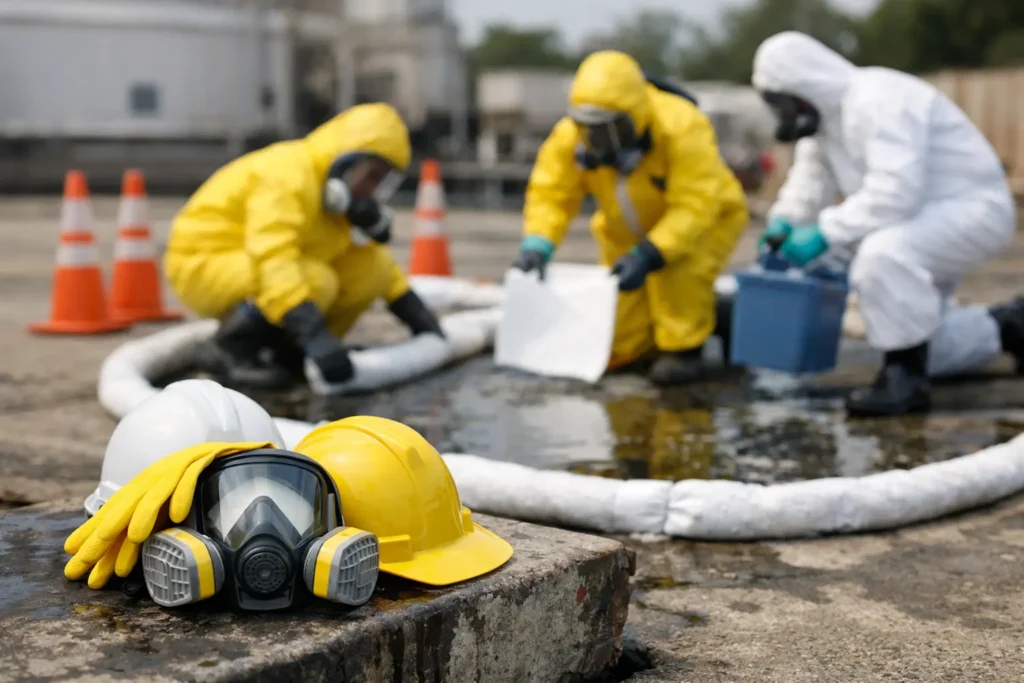
A spill kit without PPE delays response. Store the basic protective equipment in the same cabinet, wheelie bin or response point as the absorbents, drain protection and disposal bags. For vehicle kits, keep compact PPE in a sealed pouch within the bag or behind the driver’s seat, where it stays dry and easy to reach.
A practical PPE station should contain at least these distinct items:
- Gloves in the correct materials and sizes for your crew
- Splash goggles, plus a face shield where chemical handling creates splash risk
- Disposable or reusable protective clothing suited to the liquids on site
- Clearly identified disposal bags for contaminated PPE and used absorbents
- Hand-cleaning supplies and a simple spill response instruction card
Add chemical-resistant boots or overshoes where your risk assessment calls for them. For larger chemical response points, a dedicated PPE bag helps keep clean equipment separate from contaminated tools and used pads.
Check the station during routine housekeeping inspections. PPE stored beside a spill kit can go missing, expire, degrade in heat, or become the wrong size for new staff. Make the check part of your monthly spill kit review: confirm stock levels, packaging condition, glove sizes, goggle condition and disposal bag supply. Replace anything used after every incident, even if the spill was minor.
Put PPE on and take it off without spreading contamination
Good equipment can still fail if contamination is carried from a glove to a face, vehicle cab or lunchroom. Before starting, inspect each item for damage and make sure sleeves overlap gloves and clothing covers the boot opening where needed. Keep a clean person outside the work zone if the spill is more than a quick, low-risk clean-up.
When the work is complete, remove the dirtiest outer items first and avoid touching skin or clothing underneath. Place disposable PPE and saturated absorbents into suitable waste bags or containers according to the substance and your site waste process. Reusable items need decontamination based on the SDS and site procedure. Do not take chemical-contaminated coveralls home for washing.
The responder should then wash hands and any exposed skin before returning to normal duties. Record the incident, identify what caused the spill, and restock the kit straight away. A replacement pad pack or glove box is low-cost compared with discovering an empty kit during the next leak.
Train for the first five minutes
Frontline staff do not need to be chemical specialists to handle routine spills, but they do need a clear trigger for when to act and when to stop. Run short, practical drills using the actual kits on site. Ask staff to identify the correct PPE, isolate the area, protect a nearby drain, deploy absorbent socks, collect waste and locate replacement supplies.
Keep instructions simple: identify the liquid, put on suitable PPE, stop the source if safe, contain the spill, protect drains, clean up, dispose correctly and restock. Make escalation rules equally clear for unknown substances, hazardous chemicals, fire risk, fumes, large spills and confined spaces.
Equip your response point before the next incident, not after it. The right PPE, stored with the right spill kit and checked regularly, gives your team a safer, faster start when a leak hits the floor.