
Blog
Warehouse Spill Supplies That Keep Sites Ready
Aug
A leaking drum beside the racking, hydraulic oil under a forklift or a split carton of cleaning chemical can stop a warehouse shift fast. The right warehouse spill supplies let your crew isolate the hazard, protect nearby drains and get the area under control before a small leak becomes downtime, a slip risk or a costly clean-up.
For most sites, the best response equipment is not the biggest kit on the catalogue. It is the kit that matches the liquids on site, sits where people can reach it and has enough capacity for the spill your team is most likely to face. Start with the risk, then equip each work area for a fast first response.
Match warehouse spill supplies to the liquid
A spill kit is only useful when its absorbents are suitable for the substance on the floor. Warehouses often handle more than one risk, even when the core operation is straightforward. Forklifts and dock equipment may leak oil, cleaning stores may hold chemicals, and maintenance teams may use coolants, degreasers or solvents.
Oil and fuel spills
Oil and fuel kits use hydrophobic polypropylene absorbents. They soak up hydrocarbons while repelling water, making them the practical choice for diesel, petrol, hydraulic oil, lubricants and oily wastewater. Keep oil and fuel absorbents near loading docks, forklift charging or servicing areas, fuel storage and outdoor plant.
If rainwater can carry a spill towards a stormwater inlet, add drain protection to the response point. Pads alone may contain a small leak, but they are not a reliable substitute for blocking a drain early.
Chemical and hazchem spills
Chemical or hazchem kits are designed for a broader range of hazardous liquids, including acids, caustics, coolants, solvents and many common industrial chemicals. Their absorbents are usually colour-coded yellow for quick identification. If the warehouse receives chemicals in drums, IBCs or cartons, this is usually the safer all-round choice for that storage area.
Do not assume a general-purpose pad is suitable for every chemical. Check the product safety data sheet for the liquid involved, use the correct personal protective equipment and make sure your team knows when to escalate rather than clean up a spill themselves.
General-purpose spills
General-purpose kits are suited to non-aggressive workshop and warehouse liquids, such as water-based coolants, mild cleaning products, paints and mixed maintenance fluids. They are useful where the likely spill is not oil-only and the chemicals handled are low hazard.
The trade-off is clear: general-purpose absorbents offer flexibility, but they are not the answer for unknown, corrosive or highly hazardous liquids. Where in doubt, place a chemical kit near the chemical store and use general-purpose supplies for routine maintenance zones.
Size the kit for the location, not just the building
A 240-litre wheelie-bin kit may be right for a busy warehouse, but it does not help much if the only kit is parked at the far end of the building. Think in response zones. Receiving, chemical storage, dispatch, maintenance, waste handling and external loading areas can each have different spill risks and response times.
A practical set-up often includes a small kit for mobile tasks, medium kits at fixed work points and a larger central kit for major incidents. Use this guide as a starting point:
| Work area | Practical starting capacity | What to keep nearby |
|---|---|---|
| Forklift or delivery vehicle | 20L to 30L | Compact bag, pads, socks and disposal bags |
| Packing, dispatch or small maintenance area | 50L to 80L | Portable kit with pads, absorbent socks and PPE |
| Chemical store or drum handling point | 120L to 120L+ | Chemical kit, drain cover and suitable PPE |
| High-throughput dock or warehouse floor | 120L to 240L | Wheelie-bin kit, extra socks and disposal capacity |
Capacity refers to the approximate amount of liquid the absorbent media can hold. It is not a guarantee that every spill of that volume can be managed safely. Surface condition, liquid viscosity, rain, broken packaging and the need to build containment all affect how much material is used.
For drum and IBC areas, select a kit with enough socks to surround a leak and enough pads or particulate absorbent to recover the liquid inside the contained area. A single 205L drum can create a much larger incident than the visible puddle suggests, particularly if the leak is not stopped quickly.
Build a response point people can use immediately
The quickest spill response is usually the simplest one. Staff should not need to search a cupboard, borrow gloves from another department or walk across the warehouse for a disposal bag. Position kits on visible routes, near known hazards and away from areas likely to be blocked by pallets or equipment.
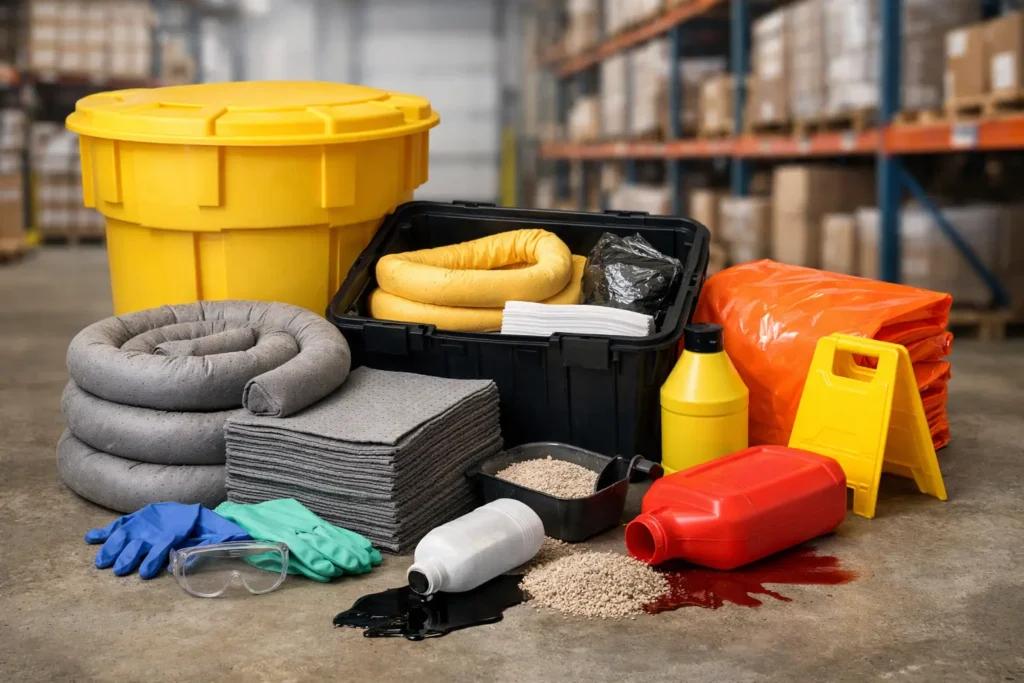
Each response point should have the basics needed to contain, absorb and dispose of a routine spill. That generally means compatible absorbent pads, socks or booms, PPE, disposal bags and instructions. For external areas and locations near stormwater, include a drain cover or drain warden that can be deployed before clean-up begins.
Keep the kit clearly marked and make ownership obvious. A site supervisor, maintenance lead or nominated shift team should check it regularly. A kit that has been opened, partly used or moved behind stock is not ready-to-deploy equipment.
Use the right absorbent format
Different absorbents perform different jobs. Buying only pads is a common mistake because pads are familiar and easy to store. They are excellent for wiping up and recovering pooled liquid, but they do not contain a spreading spill on their own.
Absorbent socks create a barrier around the spill. Place them downhill, around leaking machinery or across doorways to stop liquid spreading. For a leaking drum, form a ring first, then use pads or loose absorbent inside the ring. Pillows are useful beneath persistent drips, under valves and in tight spaces where several pads would shift around.
Loose particulate absorbent can be useful on rough concrete and irregular surfaces, but it creates more waste and can be slower to collect. Pads and socks are generally cleaner for indoor warehouse operations. The best choice depends on the surface, liquid and how quickly the area must reopen.
Protect drains before the spill travels
A warehouse spill can become an environmental issue the moment it reaches stormwater. Loading docks, external hardstands and wash-down areas need special attention because drains may be only a few metres from the leak source.
Train staff to identify the nearest drain before an incident occurs. During a spill, the first action may be placing a drain cover over the inlet or laying absorbent socks across the flow path. This is especially relevant for oil, fuel, chemicals and contaminated water.
Drain protection needs to be stored close enough to deploy in seconds. A drain cover left in a locked shed is not a workable control for a busy dock. Check the drain dimensions and surface type before ordering, as a cover must sit flat enough to form an effective seal.
Keep refills ready after every use
Minor spills quietly empty kits. A few pads used for a hydraulic leak, two socks placed under a dripping pallet and a pair of gloves removed from the bag can leave a kit short when the next incident happens. The outer case may still look full, but the response capacity has changed.
Make refill checks part of regular housekeeping and after every reported spill. Count the high-use items first: pads, socks, disposal bags, gloves and drain covers. Keep replacement absorbents in a labelled storage point near the main kit so the team can restore it straight after clean-up.
For high-use sites, it is practical to hold spare pads and socks separately from the main kit. This prevents staff using emergency stock for routine drips without replacing it. It also lets you tailor each response point as operations change.
Give the crew a simple spill sequence
Frontline staff do not need a lengthy manual to manage a routine spill, but they do need a clear order of action. Use a short, site-specific process: assess the hazard, stop the source if safe, protect drains, contain the spread, absorb the liquid, bag the waste and report the incident.
Make the limits clear. Unknown chemicals, strong fumes, large releases, damaged IBCs, fire risk or spills beyond the available kit capacity require escalation. The goal is not to ask workers to take unnecessary risks. It is to give them the equipment and confidence to act quickly when a manageable spill occurs.
Equip the warehouse before the next delivery
Walk your site from the receiving dock to the waste area and identify where a spill would travel, not just where it might start. Place the right kit at each risk point, add drain protection where runoff is possible and keep refill stock close by. Spillkits.com.au helps Australian warehouses, workshops and fleets select ready-to-deploy equipment without
complicatingthe order.
A prepared warehouse does not wait for a leak to reveal a gap in its safety equipment. Select the right kit, keep it accessible and replace what gets used. When the next drum, forklift or delivery incident occurs, your crew can respond straight away.