Blog
AS NZS Spill Kit Compliance for Australian Sites
Oct
A leaking 205L drum, a split hydraulic hose or a diesel spill beside a stormwater drain can turn into an environmental incident before the right equipment reaches the floor. AS/NZS spill kit compliance is not achieved by putting a generic kit in the corner and hoping it is adequate. Your site needs the right absorbent type, enough recovery capacity, safe access and a clear plan for keeping the kit ready to deploy.
For procurement teams, depot managers and safety coordinators, the commercial risk is immediate: an undersized or unsuitable kit can delay clean-up, expose staff to hazards, contaminate drains and leave the business struggling to demonstrate practical spill preparedness. Select equipment to suit the materials, volumes and locations on your site – then keep it stocked.
What AS NZS Spill Kit Compliance Means in Practice
Australian and New Zealand standards, environmental duties, dangerous goods requirements and workplace safety obligations all shape spill preparedness. The exact requirement depends on your state, site activity, chemicals handled and the conditions set by your regulator, insurer or principal contractor. There is no single spill-kit volume that suits every workplace.
What does apply everywhere is the expectation that foreseeable spills can be controlled quickly and safely. A compliant spill response arrangement should match the hazard profile of the operation. That means identifying what can leak, where it can travel, who will respond and what containment is needed before clean-up begins.
For a workshop, foreseeable spills may include engine oil, coolant, fuel and batteries. A transport depot may need vehicle kits for roadside incidents plus larger static kits near refuelling bays, loading areas and bulk storage. A laboratory, manufacturing site or council facility handling corrosives needs chemical-compatible absorbents and personal protective equipment, not a standard oil-only kit.
Do not treat a spill kit as a stand-alone answer. It works alongside drain protection, suitable waste disposal arrangements, bunded storage and trained people who can act immediately.
Start With the Spill Risk, Not the Kit Colour
The fastest way to buy the wrong kit is to choose by container size alone. Start by mapping your liquids and likely spill scenarios. Record the product, maximum credible release, storage point, transfer route, nearby drains and surface type. This gives you a defensible basis for selecting equipment and checking it at review time.
Match absorbents to the liquid
Oil and fuel spills require hydrophobic polypropylene absorbents. These repel water while absorbing hydrocarbons, making them the practical choice for diesel, petrol, lubricants and hydraulic oil around workshops, marine areas and wet outdoor surfaces. Oil-only absorbents are not suitable for every chemical spill.
General purpose absorbents are designed for common non-aggressive industrial liquids, including coolants, water-based fluids and many oils. They suit facilities with mixed, lower-risk maintenance spills, provided no corrosive or unknown substance is involved.
Chemical or hazchem kits are the correct choice where acids, alkalis, solvents or unidentified liquids may be present. These kits need chemically compatible pads, socks, disposal bags and protective equipment. If the safety data sheet identifies a corrosive, oxidising or otherwise hazardous liquid, confirm the response media and PPE against that product before ordering.
A single site may require all three categories. That is often the right operational decision. Keep an oil and fuel kit at the refuelling point, a chemical kit near chemical storage and a general purpose kit in the maintenance area. It is more effective than asking crews to improvise with one catch-all kit.
Size for the credible release
Kit capacity should cover the likely spill, not the average drip. A 20L vehicle bag is useful behind the driver’s seat or in a ute tray for a minor leak. It is not adequate as the sole response resource for a depot holding drums, IBCs or refuelling equipment.
Use the following practical sizing approach:
| Site scenario | Typical response capacity | Practical equipment choice |
|---|---|---|
| Service vehicle, ute or small plant | 20L to 40L | Compact vehicle spill kit with pads, socks and disposal bags |
| Workshop bay or small chemical cupboard | 50L to 120L | Portable carry bag or wheeled kit positioned near the hazard |
| Fuel island, loading dock or active warehouse | 120L to 240L | High-visibility wheelie-bin kit for rapid access |
| Drum store, IBC area or high-volume process zone | 240L plus | Multiple kits combined with bunding, drain covers and recovery equipment |
Capacity markings are a guide to absorption under controlled conditions. Real incidents vary. Uneven concrete, rain, cracked surfaces and fast-moving liquid increase the amount of socks, pads and granular absorbent needed. Where a spill can reach a drain or leave your boundary, build in extra containment rather than buying to the bare minimum.
Control the Path of the Spill
Absorbing liquid is only one part of the response. Stop it entering drains, soil or waterways first. Position drain covers and absorbent socks where teams can reach them without crossing the spill. For larger external areas, consider collapsible bunds or portable containment around leaking plant, drums or damaged packages.
Secondary containment is equally important before a leak occurs. Drums and IBCs should sit on appropriately sized bunding that can retain a credible loss, including the stored liquid and likely rainfall where units are outdoors. A drum pallet may be sufficient for routine 205L drum storage; an IBC bund is needed for intermediate bulk containers. Check the actual sump capacity, load rating and chemical compatibility before placing an order.
Flammable liquid storage needs its own controls. Where fuels, solvents or other flammable substances are stored indoors, approved flammable cabinets can reduce ignition and access risk while helping keep containers organised. The cabinet does not replace spill response equipment. Place a suitable kit and drain protection nearby, based on the liquids stored and the route a spill could take.
Build a Kit People Can Use Under Pressure
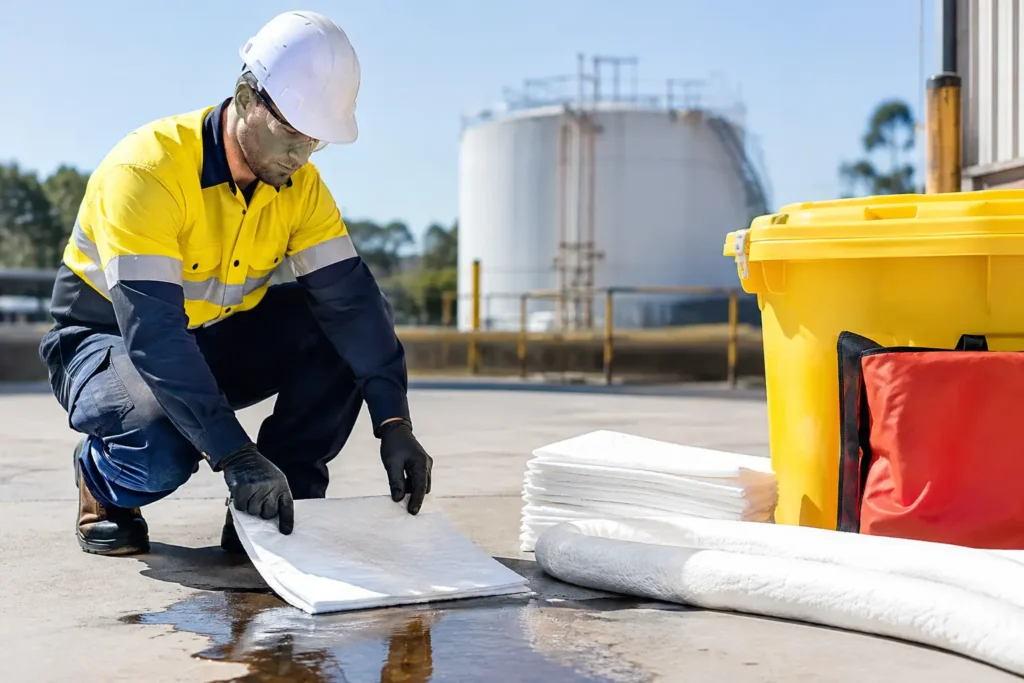
A spill kit buried behind cartons is not operationally ready. Place kits at the point of risk, mark them clearly and ensure they are accessible during deliveries, shift changes and after-hours work. Wheelie-bin kits suit busy warehouses and depots because crews can move them quickly to the incident. Compact bags are better for fleet vehicles and confined work areas.
Each kit should provide more than absorbent pads. For most commercial sites, response equipment should include containment socks, pads or rolls, disposal bags and ties, gloves, PPE appropriate to the hazard, and simple instructions. Drain covers, plugs or matting may be required where stormwater entry is a realistic risk.
Avoid overloading the kit with equipment nobody will use. A clear, correctly matched kit is better than a large container full of miscellaneous items. Train staff to isolate the source if safe, protect drains, contain the liquid, recover it and manage used absorbents as contaminated waste according to the substance and local disposal requirements.
Keep Your Spill Kits Compliant After Purchase
Compliance fails quietly when kits are opened, used for small clean-ups and never replenished. Make spill-kit inspection part of your site safety schedule. Monthly checks are common for active workplaces, while high-risk areas may need more frequent reviews.
Inspect the location, signage, accessibility and condition of the container. Check that pads are dry and clean, socks have not degraded, PPE is intact and disposal bags are available. Record what has been used and replenish it immediately. Used absorbents are not a refill plan.
Review your kit selection whenever you introduce a new chemical, change storage volumes, relocate drains, expand a workshop or add vehicles to the fleet. A move from a few 20L containers to 205L drums or IBCs changes the credible spill scenario and may require higher-capacity kits, bunding and additional drain controls.
For multi-site organisations and government facilities, standardising kit types and inspection records simplifies procurement. Keep vehicle kits consistent across the fleet, then assign larger location-specific kits for fixed operational areas. This reduces training time and makes refill ordering faster.
Order for Readiness, Not Just the Audit
When a spill occurs, the right kit must already be on site. Build an ordering schedule that includes complete kits, replacement pads and socks, chemical absorbents, drain protection and waste bags. Keep refill inventory where usage is high, particularly workshops, loading docks and fleet depots.
Spillkits.com.au supports practical purchasing for commercial, industrial and government buyers with rapid nationwide dispatch, purchase order acceptance and itemised GST on products and freight. Select the kit around your actual spill risk, add the containment equipment that stops escape, and order refill stock before the existing kit is depleted.
A kit that is correctly sized, clearly positioned and fully stocked gives your crew the one thing they need when liquid hits the floor: the ability to act straight away.