Blog
IBC Secondary Containment Sizing Guide Australia
Oct
A 1,000L IBC can turn a minor valve failure into a costly site incident fast. This IBC secondary containment sizing guide gives you a practical way to calculate required bund capacity, check the product specification and order equipment that protects your drains, stock and operating licence.
The first rule is simple: size containment for the credible spill, not the space available beside the racking. A pallet that looks right but cannot retain the required volume leaves your site exposed to clean-up costs, lost product, environmental reporting and avoidable downtime.
Start with the required containment volume
For many Australian workplaces, a common starting point is to provide capacity equal to the greater of 110% of the largest container or 25% of the total volume stored. This is widely used as a practical benchmark for liquid storage containment, but it is not a substitute for checking the dangerous goods rules, environmental requirements, lease conditions and site procedures that apply to your location and chemical.
For a single standard 1,000L IBC, 110% means a minimum containment capacity of:
1,000L x 1.10 = 1,100L
That makes a 1,100L or larger IBC bund the logical minimum starting point, provided its stated sump capacity is at least 1,100L and it suits the liquid being stored.
For two 1,000L IBCs, compare both calculations. Ten per cent above the largest container is still 1,100L. Twenty-five per cent of the total 2,000L stored is 500L. The greater figure is 1,100L, so your containment needs at least 1,100L capacity.
For four 1,000L IBCs, 25% of 4,000L is 1,000L. The 110% largest-container calculation remains 1,100L. Again, 1,100L is the higher result. The calculation changes as the number and size of containers increase, so do not assume that a four-IBC pallet is automatically sized for your compliance target.
Use this quick sizing table
| Storage arrangement | Total liquid stored | 110% of largest container | 25% of total stored | Practical minimum target |
|---|---|---|---|---|
| One 1,000L IBC | 1,000L | 1,100L | 250L | 1,100L |
| Two 1,000L IBCs | 2,000L | 1,100L | 500L | 1,100L |
| Four 1,000L IBCs | 4,000L | 1,100L | 1,000L | 1,100L |
| Six 1,000L IBCs | 6,000L | 1,100L | 1,500L | 1,500L |
Treat this table as a purchasing screen, not legal advice. Your applicable requirements may call for more capacity, separation between incompatible substances, rainwater management or dedicated containment for particular dangerous goods.
Check the listed sump capacity, not just pallet size
A frequent procurement mistake is choosing an IBC bund by footprint alone. Two units can have similar deck dimensions yet deliver very different usable containment capacity. What matters is the rated sump capacity stated by the manufacturer.
Before placing the order, check that the specification confirms:
- the number of IBCs the unit is designed to hold
- the usable sump capacity in litres
- the load rating for full IBCs, pallet jacks or forklifts where relevant
- chemical compatibility with the stored liquid
- whether a grate, dispensing shelf or ramp reduces usable containment volume
A 1,000L IBC is not always filled to exactly 1,000L, and some products are sold in 800L, 1,250L or other formats. Use the actual maximum container volume on site. If your operation receives variable container sizes, size for the largest credible delivery rather than the average load.
Also allow for what enters the sump after installation. Rainwater, wash-down water and accumulated residue can consume capacity quickly in uncovered external areas. If the bund is outdoors, inspect and manage it routinely. Never pump contaminated liquid to stormwater just to restore capacity.
Match the bund to the way your site handles IBCs
The right containment system depends on whether you are storing, decanting, transporting or temporarily staging liquid. Static warehouse storage needs a different setup to a civil crew unloading chemicals at a remote job.
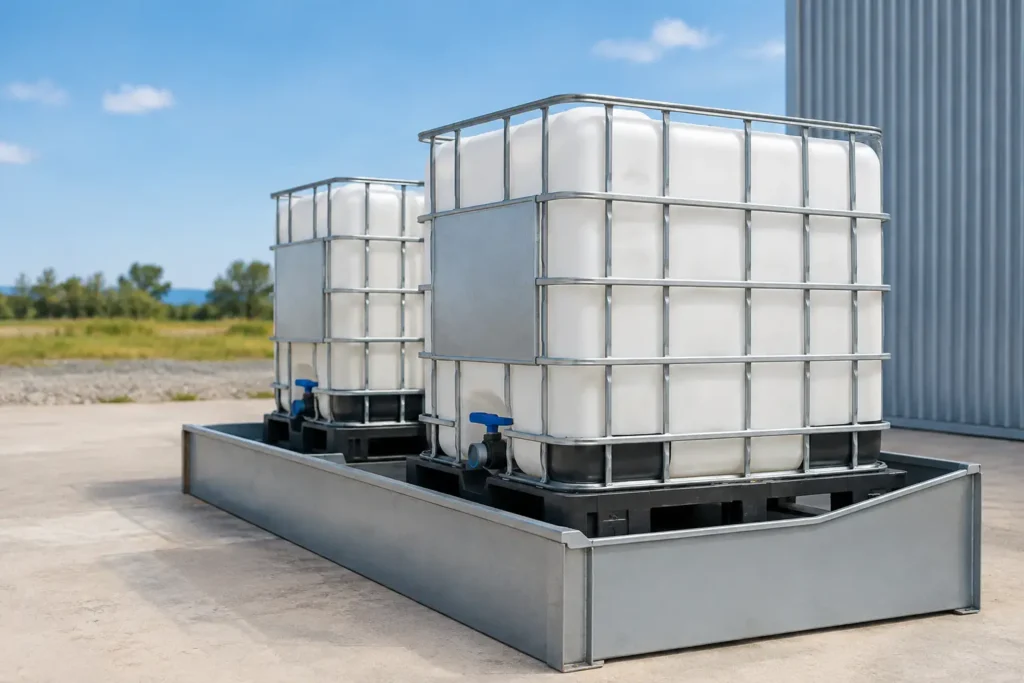
For fixed storage in a depot or workshop, a rigid polyethylene IBC bund offers dependable, ready-to-use containment. It suits many oils, fuels and chemicals, resists corrosion and keeps the IBC elevated above the captured spill. Select a model with a capacity that clears your calculation, then confirm its load rating before positioning full containers.
For temporary work zones, maintenance shutdowns or locations with changing layouts, collapsible bunds can be the better commercial answer. They are quick to deploy and easy to store, but only when the selected material is compatible with the liquid and vehicle traffic is managed correctly. Do not use a flexible bund as a shortcut where frequent forklift access or permanent IBC storage calls for a rigid unit.
When decanting from an IBC, contain the transfer point as well as the container. A bunded pallet catches a major leak, but drips at the tap can still travel across a floor and reach a drain. Position absorbent pads or socks at the dispensing point, keep a drain cover close by and maintain suitable spill kits within immediate reach.
Separate incompatible liquids before they become one spill
Capacity is only half the containment decision. If one bund holds substances that react with each other, a spill can become a vapour, fire or exposure event. Keep acids, alkalis, oxidisers, fuels and other incompatible products segregated according to the safety data sheet and your dangerous goods plan.
This matters especially in mixed-use workshops, council depots, fleet yards and warehouses where oils, coolant, cleaning chemicals, herbicides and fuels arrive through different purchasing channels. A single shared containment area may look efficient on a floor plan but create unnecessary risk at incident time.
Check the chemical compatibility of the bund material too. Polyethylene is suitable for many common industrial liquids, but no one material suits every substance at every concentration and temperature. Use the product SDS, supplier compatibility guidance and your site risk assessment before standardising a containment system.
Account for loading, access and spill response
Containment that crews cannot use safely will be bypassed. Confirm how full IBCs will enter and leave the bund, whether forklifts have sufficient clearance, and whether the floor can carry the combined weight of product, pallet and handling equipment.
A full 1,000L IBC can weigh well over one tonne once the container, pallet and liquid are included. Avoid placing containment on damaged concrete, steep grades or surfaces that direct a spill toward pits and stormwater grates. Keep access clear for emergency response and do not stack unrelated stock around the bund.
Equip the area for the liquid stored. Oil and fuel spills need hydrophobic polypropylene absorbents that repel water while capturing hydrocarbons. Chemical spills may need hazchem absorbents and suitable personal protective equipment. General-purpose absorbents are useful for many maintenance fluids, but they are not a universal answer for aggressive chemicals.
Your response equipment should be sized to the credible first-release scenario. A small 20L vehicle bag is useful behind a ute seat or in a service truck. It is not a substitute for site-level response equipment beside several IBCs. For fixed bulk-liquid areas, select a substantial spill kit, drain protection and replacement absorbents so the site can respond without waiting for a refill order.
Build a purchase check before stock arrives
Use this final check when ordering IBC containment:
- Record the maximum volume of the largest IBC and the total volume stored together.
- Calculate 110% of the largest container and 25% of total stored volume.
- Select the higher figure, then verify the bund’s stated usable sump capacity exceeds it.
- Confirm liquid and bund-material compatibility, load rating, handling access and segregation requirements.
- Add spill response equipment, drain protection and replacement absorbents for the storage area.
For procurement teams managing multiple sites, put the calculation and approved bund model on the purchase specification. That prevents a cheaper, undersized alternative being substituted when stock is reordered. It also gives supervisors a clear basis for checking incoming equipment before it is commissioned.
Spillkits.com.au supports fast ordering for commercial and government buyers, including purchase order purchasing, itemised GST for products and freight, and rapid nationwide dispatch. Secure the containment capacity first, then equip the area to control the spill before it reaches a drain.