Blog
Industrial Bunding: Size Containment Right
Oct
A 205L drum can turn a clean workshop floor, loading bay or depot yard into a costly incident in minutes. If oil, chemicals or contaminated washdown reach a drain, the immediate clean-up is only part of the problem. Industrial bunding puts a physical containment barrier between stored liquids and the environment, giving your crew time to control the release before it escalates.
For busy Australian sites, the decision is practical: identify what is being stored, calculate the required capacity, and install containment where a leak is most likely to occur. Get that right and you reduce clean-up costs, protect drainage systems and keep stock moving. Get it wrong and one failed drum, valve or forklift strike can stop operations.
What industrial bunding does on site
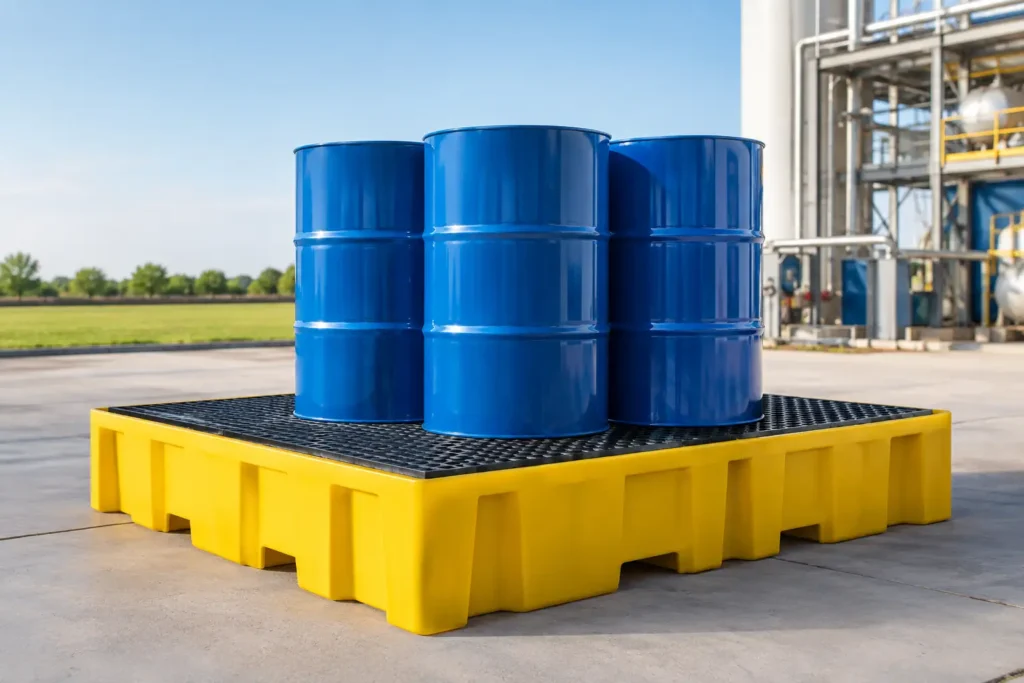
Industrial bunding is secondary containment. It is designed to catch leaks, drips and larger spills from drums, IBCs, plant and liquid handling activities when the original container fails. A bund may be a rigid polyethylene pallet, a steel bunded store, a low-profile work floor, a collapsible drive-over bund or a purpose-built containment area.
The right unit does more than hold liquid. It separates incompatible substances, protects stormwater drains, creates a defined storage zone and makes inspections faster. When drums are sitting directly on concrete, small leaks can travel unnoticed under pallets or along surface falls. Put them on a properly sized spill pallet and the evidence is contained where your team can see and manage it.
This is especially relevant in workshops, warehouses, transport depots, civil compounds, councils, utilities and government facilities where oils, fuels, coolants, solvents, paints, agricultural chemicals or cleaning products are held in working quantities. Storage is only one risk point. Decanting, refuelling, maintenance and waste-liquid collection need containment as well.
Size industrial bunding before you order
Capacity is the first specification to confirm. A common benchmark for liquid storage is containment equal to at least 110% of the largest container or 25% of the total stored volume, whichever is greater. Your applicable Australian Standard, dangerous goods classification, state requirements, site procedures and insurer conditions may impose different or additional requirements. Confirm the rule that applies to your material and storage arrangement before purchase.
The calculation is straightforward, but it must reflect the actual inventory rather than the number of empty positions on a pallet.
If you store four 205L drums, total volume is 820L. Twenty-five per cent is 205L. One hundred and ten per cent of the largest drum is 225.5L. In that case, select bunding with at least 225.5L of sump capacity, then allow a sensible margin where rainwater, frequent handling or multiple fluids are involved.
For two 1,000L IBCs, the total stored volume is 2,000L. Twenty-five per cent is 500L, while 110% of the largest container is 1,100L. The larger figure applies, so you need at least 1,100L of usable containment capacity. Do not assume an IBC pallet is compliant because it physically holds two IBCs. Check the stated sump volume.
Capacity is not the only fit check
A correctly sized bund still fails the job if forklifts cannot approach it safely, the pallet surface cannot carry the load, or the chemical attacks the construction material. Check the loaded weight of drums or IBCs, the forklift entry direction, ramp requirements, grate load rating and available aisle width.
Polyethylene bunds suit many oils, fuels and chemicals because they resist corrosion and are easy to clean. Steel bunding can be appropriate for specific applications, but compatibility with the stored liquid and exposure conditions must be checked. Strong oxidisers, aggressive chemicals and flammable liquids may require more specific segregation and storage controls than a general-purpose pallet can provide.
Match the bund to the work area
The best containment format depends on how liquid moves through your site. Permanent drum storage needs a different solution from occasional vehicle servicing or an outdoor transfer point.
Drum storage and waste oil stations
For 205L drums, choose a one-, two- or four-drum spill pallet with enough sump capacity for your storage volume. Units with removable grates make it easier to inspect and recover collected liquid. Where drums are dispensed from taps or pumps, use a bunded dispensing station or place a compatible drip tray beneath connection points. Most leaks start at bungs, hoses and taps, not from dramatic drum failures.
Keep full and waste drums separate where possible. Waste oil, coolant and used chemicals can create compatibility and labelling problems quickly. Clearly mark the storage zone and maintain access for drum lifters, trolleys and spill-response equipment.
IBC storage and decanting
IBCs concentrate a large volume of liquid in a small footprint, making containment capacity critical. Select an IBC bund with a published sump volume that meets your calculation, plus adequate static load rating for a full 1,000L container. If staff decant product from the IBC, confirm that the outlet valve remains inside the contained area.
For active transfer points, a larger bunded work floor can be safer than a narrow pallet. It gives operators room to manage hoses, pumps and containers without stepping outside the containment zone. Add drain protection nearby so a hose failure cannot reach stormwater while your team responds.
Mobile work, wash bays and vehicle areas
Rigid pallets are not always practical where utes, service trucks, forklifts or mobile plant need to enter the area. Collapsible bunds provide temporary containment for maintenance, refuelling, washdown and field work. The trade-off is discipline: walls must be raised before work starts, and vehicle traffic must only use systems designed for drive-over access.
For a workshop bay, position containment where the work happens rather than hoping a spill can be pushed towards a drain cover after the fact. Keep absorbent pads, socks and disposal bags within reach. A bund contains the liquid; the response kit removes it.
Protect drains and stock the response gear
Bunding is not a replacement for spill response. It is the first barrier that keeps a release manageable. Your crew still needs the right absorbents for the liquid involved, a method to seal drains and a clear escalation process.
Oil and fuel spills need hydrophobic polypropylene absorbents that repel water while taking up hydrocarbons. Chemical spills may require hazchem absorbents selected for the material and compatible personal protective equipment. General-purpose absorbents are useful for coolants, water-based liquids and routine workshop leaks, but they are not the right choice for every chemical.
Place response equipment beside the risk, not in a locked store at the other end of the site. A compact vehicle kit belongs behind the driver’s seat or in a side compartment. A busy warehouse or depot needs higher-capacity equipment near chemical storage, loading zones and drains. Refill used items immediately so the kit remains deployment-ready for the next incident.
Avoid the bunding mistakes that create exposure
Most containment failures come from selection, maintenance or housekeeping gaps rather than a defective product. Control these four issues before they become an incident:
- Undersized sump capacity: Measuring the pallet footprint but not checking its stated liquid capacity leaves you short when a container fails.
- Rainwater left in outdoor bunds: Water displaces available containment volume. Inspect after rain and manage collected liquid in line with site procedures.
- Incompatible liquids stored together: A bund may contain a leak but cannot prevent a reaction between incompatible materials. Segregate by chemical class and consult the SDS.
- Damaged grates, walls or ramps: Forklift impacts, cracked polyethylene and bent steel reduce safe loading and containment performance. Inspect before every delivery and during routine checks.
Also avoid treating a pallet as general storage. Empty containers, loose tools and rubbish reduce access and can obstruct inspection. Keep bunds clear enough for operators to spot a leak immediately.
Make procurement quick without guessing
Start with container type, number of units, liquid classification and location. Then confirm required sump capacity, load rating, footprint and whether the application needs static storage, dispensing or vehicle access. This gives procurement teams a clear specification and prevents a costly second order.
For multi-site operators, standardise bunding sizes where practical. A nominated four-drum pallet for workshops, a compliant IBC bund for depots and a collapsible unit for mobile crews simplify training, stock control and replacement ordering. Site-specific exceptions should be documented where chemical compatibility or access conditions demand them.
Spillkits.com.au supports commercial and government purchasing with rapid nationwide dispatch, purchase order acceptance and itemised GST for products and freight. Equip your fleet, workshop or storage compound before the next delivery arrives, not after the first leak reaches the drain.
A clean, empty bund is not just another pallet on the floor. It is ready containment capacity when your operation needs it most. Check your stored volumes this week, match each risk area to the right bund, and keep response gear beside it.