Blog
Do IBCs Need Bunding? Australia’s Site Check
Sep
A 1,000L IBC can turn a small valve failure, fork-tine strike or decanting mistake into a major clean-up within minutes. So, do IBCs need bunding? For many Australian workplaces, the practical answer is yes: if the container holds a liquid that could pollute drains, soil or waterways, create a fire risk, or expose people to harmful chemicals, secondary containment is usually essential.
Do not treat the IBC cage as containment. It is only the outer frame protecting the inner bottle. A bund captures leaks before they reach a drain, loading yard or neighbouring property, keeping the incident contained while your team deploys absorbents and manages the recovery.
When do IBCs need bunding?
IBCs commonly need bunding when they store fuels, oils, chemicals, pesticides, cleaning agents, coolants, acids, alkalis or other liquids with environmental or safety consequences. The precise duty depends on the product, storage volume, site location, Safety Data Sheet (SDS), relevant Australian Standard, state or territory environmental rules, and any conditions imposed by your insurer, landlord or client.
For flammable and combustible liquids, storage and handling requirements may be guided by AS 1940. Corrosive substances and other dangerous goods can trigger different requirements, including segregation, compatible materials and protected storage arrangements. Your SDS identifies the chemical hazards, but it does not replace a site-specific containment assessment.
The question is not simply whether an IBC leaks today. Ask what happens if it does. If a spill can reach a stormwater grate, workshop drain, unsealed ground, public area or waterway, install a purpose-sized IBC bund before the container arrives on site.
Use containment capacity that matches the risk
A common secondary containment benchmark is capacity for at least 110% of the largest container, or 25% of the total volume stored, whichever is greater. One full 1,000L IBC therefore often calls for at least 1,100L of available bund capacity. Two or more IBCs in one area may require significantly more.
This is a useful starting point, not a substitute for checking the applicable rules for your chemical and jurisdiction. Capacity can also be reduced in practice by rainwater, debris, pallets or equipment stored inside the bund. If your IBCs are outside, choose covered storage where possible or actively inspect and manage water accumulation. A bund full of rain cannot contain a leak.
Do not assume a low-profile pallet is automatically large enough for every IBC arrangement. Confirm the stated sump capacity, number of IBC positions, load rating and chemical compatibility before ordering. A unit must safely support the full operating weight as well as retain the required spill volume.
Select the right IBC bund for the job
The best bund depends on where and how you use the IBC. Fixed chemical storage, temporary civil works, depot decanting and transport-support operations have different demands.
Static warehouse and workshop storage
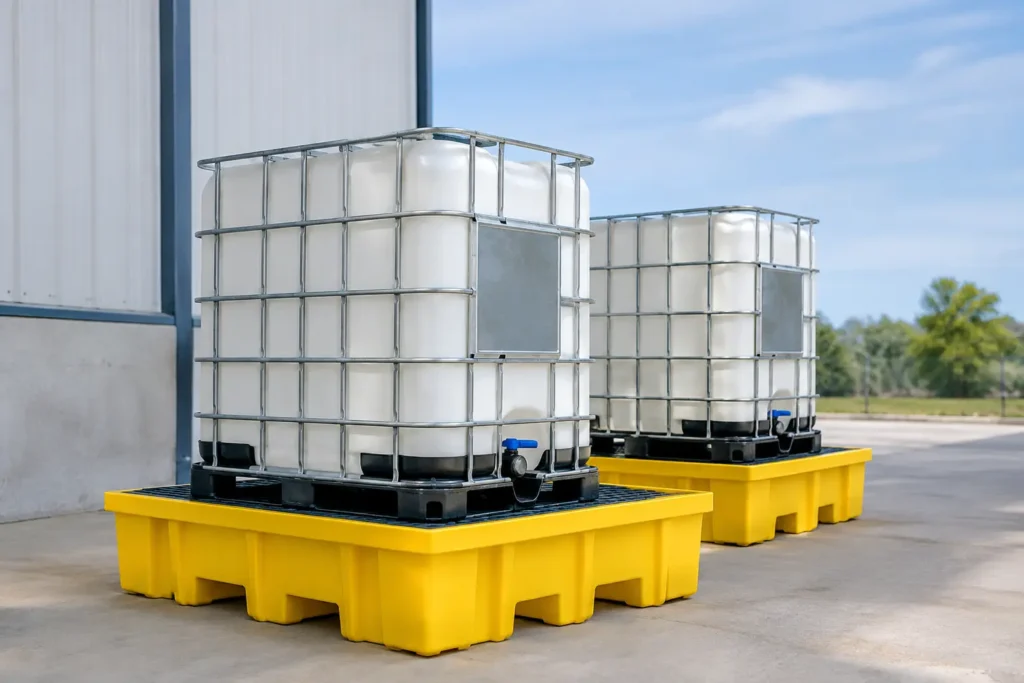
For a stable storage location, an IBC bund pallet provides a contained base beneath one or more IBCs. It keeps leaks off the concrete, creates a defined storage zone and makes inspections simpler. Select a polyethylene option for broad chemical resistance where suitable, or a steel unit where the stored product and site conditions make it appropriate.
Check that the IBC can be loaded safely with a forklift, that dispensing valves remain accessible, and that no one needs to step into the bund to operate the outlet. If dispensing is routine, allow space for controlled transfer and keep compatible absorbent material within reach.
Outdoor yards and exposed loading areas
Outdoor storage raises two risks at once: a leaking IBC and contaminated rainwater. Place containers away from drains and traffic routes, protect them from vehicle impact, and consider a roofed compound or weather-resistant cover. Drain protection should be ready before a transfer begins, not fetched after liquid has entered the grate.
Where temporary work creates changing storage locations, collapsible bunds can provide flexible containment for short-term projects, maintenance shutdowns and mobile response work. Confirm the bund wall height, internal dimensions, chemical suitability and vehicle or equipment access before deployment.
Decanting and transfer points
Many IBC spills occur during dispensing rather than storage. A damaged tap, overfilled drum or disconnected hose can release product quickly. Position the IBC and receiving container within secondary containment, use compatible fittings, and keep the valve protected from fork traffic.
For fuel and oil, use hydrophobic polypropylene absorbents that repel water and target hydrocarbons. For chemicals, use chemical-rated absorbents selected for the substance involved. General-purpose pads are not a universal answer, particularly around aggressive acids, alkalis or unknown liquids.
Avoid the costly bunding mistakes
A bund can create false confidence when it is undersized, incompatible or poorly maintained. These are the failures that leave sites exposed:
- Buying for footprint only and ignoring actual sump capacity.
- Storing multiple IBCs in a single bund without recalculating containment volume.
- Mixing incompatible chemicals in one containment area.
- Leaving dispensing valves exposed to forklifts, pallets or passing plant.
- Letting rainwater, rubbish or unused equipment consume bund capacity.
- Assuming a spill kit replaces secondary containment.
A spill kit controls and cleans up a release. Bunding stops the release travelling. You need both controls working together, especially in busy workshops, depots, construction compounds and fleet yards.
Build an IBC storage area that holds up under pressure
Start with the SDS and identify the liquid, its dangerous goods class, expected storage volume and credible spill scenario. Then map the surrounding area: drains, doorways, vehicle routes, unsealed ground, ignition sources and neighbouring stock all affect the correct setup.
Next, calculate required containment capacity and select a bund with enough rated sump volume and load capacity. Separate incompatible products rather than treating one large bund as a solution for every liquid. Fuels, corrosives, oxidisers and unknown substances need deliberate segregation based on their SDS requirements.
Finally, equip the area for the spill that bunding cannot prevent – the release during transfer or the leak outside the containment zone. Keep drain covers, suitable absorbents, disposal bags and PPE close to the work area. For high-risk storage, a clearly marked chemical or oil and fuel spill kit gives crews the materials needed to act immediately.
Inspect the setup weekly and after any delivery, forklift contact or severe weather. Look for cracked pallets, blocked access, leaking taps, stained concrete, pooled water and missing absorbents. Record inspections where your site system requires it. This takes minutes and can prevent a reportable environmental incident.
What buyers should confirm before ordering
Procurement should not have to decode vague product descriptions. Before selecting IBC bunding, confirm the number and size of containers, liquid type, desired sump capacity, maximum load, indoor or outdoor placement, forklift access and dispensing method. Measure the available area, including turning clearance for the forklift and space to safely open valves.
If your site needs fast replenishment, order the containment and response equipment together. Pair the bund with compatible absorbent pads, socks for surrounding drains, a drain cover and a spill kit matched to the liquid stored. This avoids the common gap where a new IBC arrives before the site has the equipment to control a failure.
Commercial and government buyers can also simplify repeat purchasing by providing a purchase order, requesting itemised GST for products and freight, and standardising approved containment sizes across multiple locations. Rapid nationwide dispatch helps get a compliant storage area operating without delaying deliveries, maintenance work or fleet servicing.
The practical decision
If an IBC contains liquid that could harm people, property or the environment, plan for bunding as part of the storage system, not as an optional add-on. Verify the applicable requirements, size the containment for the real volume on site, and keep spill response equipment beside the risk. Secure the IBC area before the next delivery – it is far cheaper than containing a 1,000L release after it reaches the drain.
Relevant products: Explore 1000L Single IBC Polyethylene Spill Pallet Bund and Double IBC Polyethylene Spill Pallet Bund 1000L to select equipment suitable for your site and the liquids involved.