
Blog
Drain Pollution Prevention Guide for Industrial Sites
Aug
A small oil leak at a workshop wash bay can become a costly environmental incident the moment rain carries it into a stormwater drain. The same applies to chemical decanting areas, loading docks, fleet yards and construction compounds. This drain pollution prevention guide gives site managers, procurement teams and frontline crews a direct plan: identify drainage risk, stop contaminants at the source and keep the right containment equipment ready for immediate deployment.
Drain protection is not a box-ticking exercise. Once a contaminant enters site drainage, recovery becomes slower, more expensive and far harder to control. Secure your response before the next delivery, rainfall event or equipment failure exposes the gap.
Start With the Drains That Matter Most
Walk the site with a current drainage plan, then physically inspect every pit, grate and channel. Do not assume all drains lead to the same place. Stormwater drains may discharge to waterways or council infrastructure, while trade-waste and sewer connections follow different rules. Mark each drain clearly and make the map available where spills are most likely to occur.
Prioritise drains within or downhill from high-risk activities. This commonly includes fuel dispensing points, vehicle servicing bays, chemical storage rooms, battery charging areas, waste skips, wash-down zones, loading docks and bulk liquid transfer points. A drain 20 metres from a drum storage area can be a higher operational risk than one directly beside it if the surface falls towards it.
For busy sites, use a simple three-level approach. High-risk drains need dedicated covers or isolation devices stored close by. Medium-risk drains need accessible protection within the nearest spill station. Lower-risk drains still need to be identified on the emergency plan and checked after storms, maintenance work or changes to site layout.
Stop Pollution Before It Reaches the Grate
The best drain response starts well before a spill reaches the footpath, kerb or drain inlet. Keep drums, IBCs and waste containers inside suitable secondary containment. Use bunding that can contain the likely release volume, not merely the container footprint. Check your applicable environmental duties, dangerous goods requirements and site-specific procedures when setting capacity.
For 205L drums, select drum bunding with enough usable sump capacity for the stored volume and realistic spill scenario. For IBCs, use purpose-built IBC bunds rather than relying on a few absorbent pads around the pallet. Pads help with drips. They do not replace containment when a valve fails or a forklift contacts a container.
Control the common causes of runoff contamination as part of normal housekeeping:
- Keep lids, bungs and taps closed when containers are not in use.
- Inspect hoses, fittings and dispensing equipment before transfers.
- Remove used absorbents and damaged containers promptly.
- Keep outdoor waste storage covered and contained.
- Schedule wash-down only where wastewater is managed appropriately.
These controls reduce exposure, but they do not remove the need for drain protection. A sudden hose rupture can put tens of litres on the ground in seconds. Equip the area accordingly.
Select Drain Protection for the Spill You Actually Face
Drain covers, drain seals and inflatable drain plugs are designed for different conditions. Choose for surface type, drain size, liquid type and expected response time. Buying the cheapest option without checking fit can leave a crew holding a cover that will not seal over a raised grate or uneven concrete.
Drain covers for rapid surface sealing
Flexible drain covers are the fastest option for flat, relatively smooth surfaces. A weighted polyurethane or similar cover can be placed directly over a grate to create a temporary seal while the spill is contained and cleaned up. Keep covers clean, flat and easy to access. If they are folded under old equipment or stored in a locked office, they are not response equipment.
Measure the full grate and allow sufficient overlap on every side. A cover that only matches the opening may allow liquid to track beneath its edges. For large grated pits, select a larger cover or combine upstream containment with a cover sized for the drain.
Drain plugs and isolation devices for pits and pipes
Where site drains include accessible pit outlets or pipe entries, an inflatable drain plug can provide a more positive temporary isolation point. These tools require trained operators, suitable sizing and safe access. They are valuable for industrial sites with known drainage layouts, but they are not a substitute for a first-response cover at the spill location.
Use plugs only where your emergency procedure permits it. Blocking a line without understanding upstream flow can create flooding or move the problem elsewhere.
Absorbent socks to divert and contain
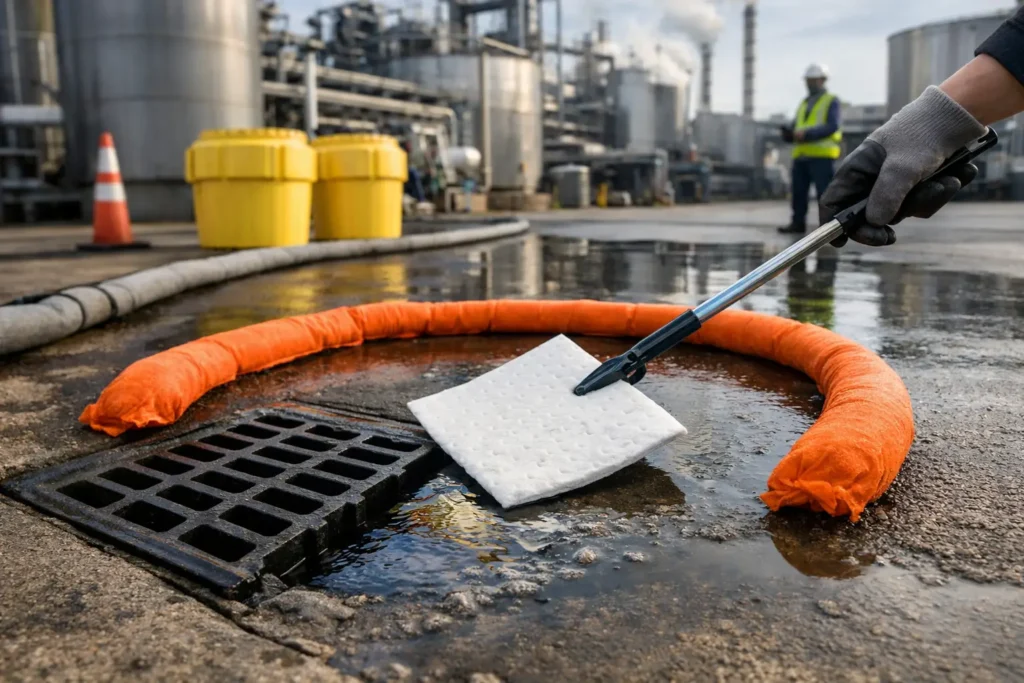
Absorbent socks are practical for building a temporary barrier around drains, across shallow flow paths or around leaking equipment. For oils and fuels, use hydrophobic polypropylene absorbents that repel water while absorbing hydrocarbons. For unknown liquids or chemical spills, use chemical-rated absorbents compatible with the substance involved. General-purpose absorbents suit many non-aggressive workshop liquids, but they are not the default answer for every chemical.
A drain cover stops entry at the grate. Socks slow and redirect liquid before it gets there. In a serious release, use both.
Build a Drain Response Station Near Every Risk Zone
A spill kit located on the other side of a warehouse is not a rapid response solution for an outdoor loading area. Place equipment where a single worker can reach it immediately, without searching for keys or waiting for a supervisor.
A practical drain-response station should hold a correctly sized drain cover, absorbent socks, pads, disposal bags, gloves, protective eyewear and clear response instructions. Add compatible chemical PPE where hazardous liquids are handled. For larger sites, position stations at fuel islands, chemical stores, wash bays and loading zones rather than relying on one central cabinet.
Match kit capacity to credible spill volume. A 20L vehicle bag works for minor leaks behind a driver’s seat or in a ute tray. It is not sufficient for a 200L drum failure at a depot. A 120L or 240L wheelie-bin spill kit provides greater absorbent capacity and is easier to move across larger yards. Select oil and fuel kits for diesel, petrol, hydraulic oil and other hydrocarbon risks; chemical kits for acids, caustics and unknown hazardous substances; and general-purpose kits for ordinary maintenance spills.
Do not overlook refill stock. After one response, a depleted kit creates a false sense of readiness. Keep replacement pads, socks, disposal bags and PPE on hand, and assign a nominated person to inspect stock monthly and after every incident.
Make the First Five Minutes Automatic
When a spill occurs, crews need simple instructions they can follow under pressure. Your site procedure should reflect the SDS, the substance, likely hazards and local emergency requirements, but the immediate priorities remain consistent: protect people, stop the source if safe, protect drains, contain the spread and escalate early.
Use this order on the ground:
- Keep people clear and use suitable PPE.
- Stop or isolate the leak only if it is safe to do so.
- Cover the nearest drains immediately.
- Place absorbent socks downhill and around the spill perimeter.
- Apply the correct absorbent media, collect contaminated material and arrange disposal through approved channels.
- Report the incident, inspect the drainage path and replenish equipment before work resumes.
Do not wash a spill into a drain, even when the surface looks clean afterwards. Water can spread contamination beyond the original area and complicate clean-up. If material has entered drainage, activate the escalation process immediately. Early reporting gives your business the best chance of limiting environmental harm and meeting notification obligations.
Check Your Equipment Before It Becomes an Emergency
Drain covers can harden, tear or disappear into general stores. Absorbents can be used for routine drips and never replaced. Bunds can fill with rainwater, reducing available containment capacity. These are predictable failures, so manage them through scheduled inspections rather than discovering them during a spill.
Inspect high-risk areas monthly and after major weather events. Confirm drain covers are the correct size and remain clean. Check bunds for cracks, blocked outlets and accumulated rainwater. Verify spill kit seals, stock levels and labels. Run short spill drills with the people who actually work in the area, including contractors and night-shift crews.
Procurement teams can make this easier by standardising approved equipment across sites. Set a minimum drain-response inventory by risk zone, maintain itemised records for equipment and freight, and use purchase orders where required. Spillkits.com.au supports PO purchasing, itemised GST documentation and rapid nationwide dispatch, helping operations replace depleted stock without unnecessary downtime.
Turn Drain Protection Into Everyday Site Control
Drain pollution prevention works when equipment, procedures and purchasing controls meet at the point of risk. A correctly sized drain cover beside the fuel bay, chemical-compatible socks at the decanting station and adequate bunding beneath bulk containers give crews a practical line of defence before runoff becomes an incident.
Walk your highest-risk drainage route this week. Measure the grates, check the fall of the surface, inspect your spill kit and replace anything missing. The right equipment on site today is far cheaper than trying to recover contamination after it leaves your boundary.