Blog
IBC Bunding Comparison: Choose the Right Containment
Oct
A full IBC can put 1,000 litres of oil, coolant, chemical or waste liquid onto the floor in minutes if a valve is knocked open or a container fails. That is not a housekeeping issue. It can shut down loading areas, contaminate drains and leave your business scrambling for cleanup equipment. This IBC bunding comparison gives Australian sites a direct way to select secondary containment before a minor leak becomes an operational incident.
For workshops, warehouses, depots, civil projects and government facilities, the right answer is usually determined by three facts: how many IBCs you store, what liquid they contain, and whether the location is permanent or temporary. Secure capacity first. Then select a bund design that suits forklift access, dispensing work and site layout.
IBC Bunding Comparison: What You Are Actually Choosing
IBC bunding is secondary containment placed beneath or around an intermediate bulk container. Its job is to capture leaks, drips and major releases from the IBC, tap, hose or dispensing connection. It is not a substitute for sound container handling, but it is the control that limits where a spill can travel.
Do not buy solely on the number of containers a unit holds. A two-IBC pallet may physically fit two IBCs but still be wrong for your site if its sump capacity is inadequate, its chemical compatibility is uncertain, or it cannot be accessed safely by your handling equipment.
For most liquid storage arrangements, a practical benchmark is containment sized for at least 110 per cent of the largest container or 25 per cent of total stored volume, whichever is greater. Your duty holder should also check the specific requirements applying to the liquid, storage quantity, location and relevant state or territory regulator. Dangerous goods, pesticides, oils and trade-waste risks can bring additional controls.
Rigid IBC Bunding Pallets
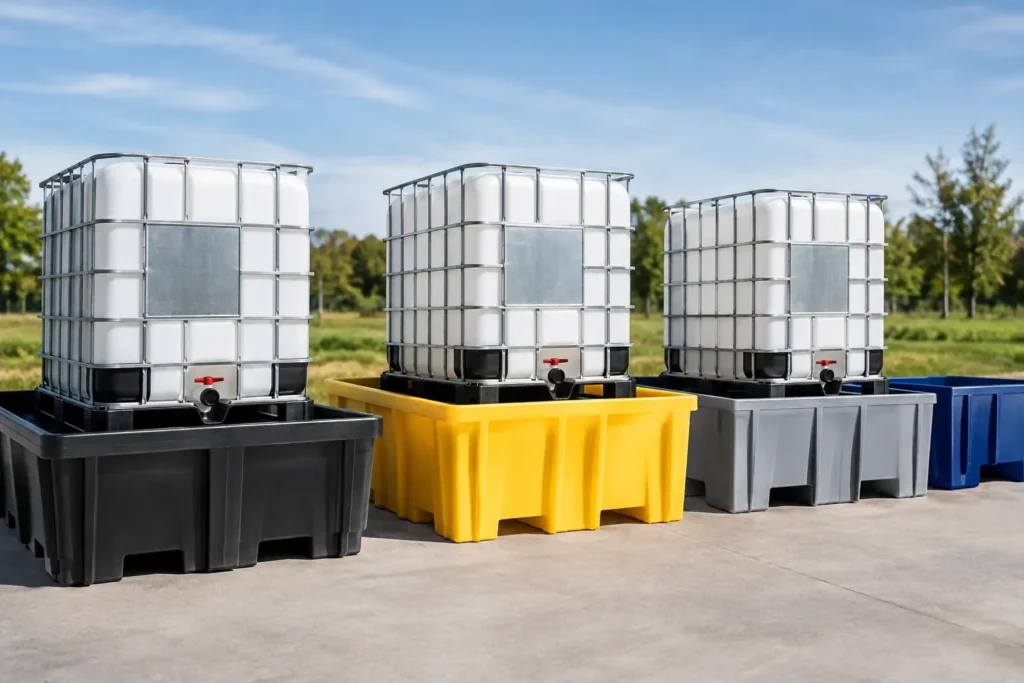
Rigid polyethylene IBC bunding pallets are the standard choice for fixed storage and routine dispensing. They provide a defined sump, a stable deck and predictable positioning for one, two or more containers. For a warehouse chemical station or a fleet maintenance depot, this is usually the fastest route to orderly containment.
Choose a single-IBC pallet where products must be segregated, where stock turns quickly, or where individual IBCs are dispensed at separate workstations. A two-IBC pallet suits paired products and can reduce floor space, while multi-IBC units work best in planned bulk-storage zones with clear forklift lanes.
The trade-off is footprint and permanence. Rigid units consume valuable floor area and must be positioned before containers arrive. Confirm the loaded capacity, fork-entry arrangement and whether grates can be removed for cleaning. If operators use drum pumps or IBC taps, ensure the working height allows safe access without improvised steps.
Modular Bunding Systems
Modular bunding uses interlocking floor sections and bund walls to create containment around multiple IBCs, drums or equipment. This option makes sense when standard pallets do not match the footprint, when you need a dedicated decanting area, or when a storage zone will expand over time.
It is particularly useful for mixed inventories. A site may store lubricants, coolants and non-compatible chemicals in separate bays, each with its own containment logic. Modular layouts can preserve access aisles while keeping each area controlled.
However, modular bunding needs better planning than a drop-in pallet. Measure the area, identify vehicle movements, allow for loading access and decide where any accumulated liquid will be inspected and removed. A poorly planned layout can create trip edges, restrict emergency access or make leaks harder to see. Use it where the flexibility delivers a real operational benefit, not merely because the storage area is awkward.
Collapsible Bunds
Collapsible bunds are built for mobile, temporary and irregular work. They are a practical choice beneath IBCs used at remote projects, maintenance shutdowns, fuel transfer points and civil worksites. When empty, they pack down for transport and can be deployed where permanent infrastructure is unavailable.
Their advantage is speed. Set up a contained work zone before a transfer starts, then pack it away when the work is complete. This makes collapsible bunds valuable for crews moving between sites or responding to short-term storage needs.
The compromise is that they require disciplined use. The bund wall must be fully raised, the ground must be reasonably level and sharp objects must be cleared before deployment. They are not the preferred option for a permanently busy forklift zone, frequent hard-wheeled traffic or unattended long-term chemical storage. If traffic must cross the bund, specify a suitable drive-through configuration rather than flattening a wall and defeating the containment.
Compare IBC Bunding Types Before You Order
| Bunding type | Best fit | Key strength | Watch for |
|---|---|---|---|
| Single IBC pallet | Segregated products and point-of-use dispensing | Compact, clear containment per container | Check sump capacity and dispensing height |
| Two or multi-IBC pallet | Fixed bulk storage in warehouses and depots | Efficient footprint for multiple containers | Requires planned forklift access and product compatibility checks |
| Modular bunding | Custom storage bays and growing inventories | Layout flexibility and defined work zones | Needs careful design, drainage control and inspection |
| Collapsible bund | Temporary projects, field crews and transfer tasks | Portable and quick to deploy | Ground condition, wall integrity and traffic suitability |
The comparison is straightforward: select rigid pallets for stable, repeatable storage; choose modular systems where the area or inventory demands a tailored footprint; use collapsible containment when the job moves. Do not force a portable product into a permanent application simply because it is easier to store when empty.
Size the Sump for the Real Spill Scenario
Start with the largest IBC volume, not the expected drip. A 1,000-litre IBC is common, but confirm the actual nominal capacity of every container on site. Then add the volumes of other containers sharing the same contained area and apply the applicable sizing rule.
Also account for rain if the bund is outdoors. Open bunds can fill with water, reducing available spill capacity before a leak occurs. Where possible, protect external storage from weather, inspect it routinely and remove uncontaminated water only under your site procedure. Never treat a full bund as a drain or allow unknown liquid to run to stormwater.
Chemical compatibility matters just as much as capacity. Polyethylene bunding is widely used because it resists many oils, fuels and chemicals, but buyers must verify suitability for the actual liquid, concentration and temperature. Strong oxidisers, solvents and corrosives may need specific materials, segregation or storage arrangements. Label every IBC clearly and keep incompatible substances out of the same containment area.
Build a Complete Spill-Control Station
Containment stops spread. It does not clean up the release. Position suitable response equipment close enough for immediate use without placing it inside a likely spill path. Oil and fuel releases need hydrophobic polypropylene absorbents that repel water, while chemical spills may require chemical-rated absorbents and PPE selected for the substance involved.
For busy depots and workshops, pair IBC bunding with heavy-duty spill kits, absorbent pads and socks, and drain protection for nearby stormwater inlets. The result is a controlled response sequence: stop the source if safe, protect the drain, contain the liquid, absorb it, then arrange compliant waste disposal.
Check the dispensing point too. Most routine losses happen at valves, hoses and drums being filled from IBCs, not from dramatic container failures. Fit compatible taps, keep absorbents within reach and inspect fittings before each transfer. A small drip tray may help manage daily handling, but it does not replace the required capacity of the primary bund.
Order for Site Readiness, Not Just Price
Before placing a purchase order, confirm the IBC count, largest container size, liquid compatibility, required containment capacity, available footprint and handling method. Ask whether forklifts need approach from one side or two, whether containers will be stored indoors or outdoors, and whether staff need to dispense directly from the unit.
For procurement teams, specify the required capacity and intended use in the order description so the delivered product matches the risk. Spillkits.com.au supports commercial and government purchasing with purchase order acceptance, itemised GST for products and freight, and rapid nationwide dispatch. That helps site teams replace damaged or undersized containment without waiting for a lengthy sourcing cycle.
Inspect bunding on arrival and add it to routine site checks. Look for cracked decks, distorted walls, damaged grates, chemical residue and rainwater accumulation. Keep the surrounding floor clear so leaks remain visible and forklift drivers can position loads accurately.
The best IBC bund is the one that contains your largest credible release, fits how your crew actually works and is in place before the next delivery truck arrives. Select the right containment now, stock the matching spill response equipment, and keep your operation moving when pressure is on.
Relevant products: Explore 1000L Single IBC Polyethylene Spill Pallet Bund and Double IBC Polyethylene Spill Pallet Bund 1000L to select equipment suitable for your site and the liquids involved.