
Blog
Warehouse Emergency Spill Plan: Act Before It Spreads
Sep
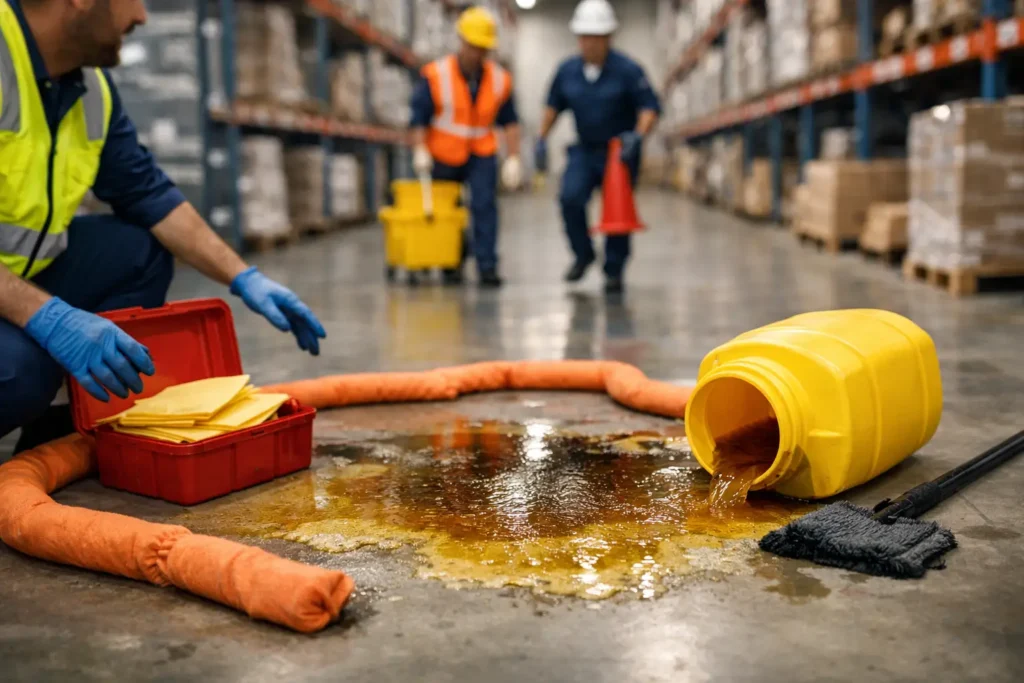
A leaking 205L drum can reach a floor drain before the supervisor has finished calling the safety team. Once liquid leaves the immediate work area, the clean-up becomes more expensive, stock can be damaged, access routes can close and environmental reporting may follow. A practical warehouse emergency spill plan gives every worker a clear first response, puts the right equipment within reach and stops a manageable incident becoming site-wide downtime.
This is not a document to file away for an audit. It is an operational instruction backed by stocked equipment, assigned people and regular checks. Build it around the liquids you actually store, transfer and move through the warehouse.
Start with the spill risks on your floor
Walk the warehouse from receiving through to dispatch. Identify where oil, fuel, coolants, detergents, acids, alkalis, paints, solvents or unknown liquids could be dropped, decanted, punctured or overturned. Include battery-charging areas, maintenance bays, chemical stores, loading docks, waste holding points and vehicle parking.
The correct response depends on the substance. Hydrophobic polypropylene absorbents are designed to repel water while taking up oil and fuel, making them suitable for many hydrocarbon spills. Chemical absorbents are required where hazardous liquids may react, burn, corrode or harm workers. General-purpose media suit common non-aggressive workshop liquids, but should never be treated as a substitute for chemical-rated response equipment.
Record the largest credible spill at each location. That may be a 20L pail in a packing area, a 205L drum in storage or several drums at a transfer point. Your plan should also account for a spill that reaches a drain, travels under racking or occurs from a vehicle at the dock. Do not size equipment only for the smallest container on site.
Build a warehouse emergency spill plan people can use
Keep the plan concise enough for a shift worker to follow under pressure. Display a one-page response sequence at spill kit stations and include the full procedure in your site safety system. Confirm the requirements that apply to your facility, chemicals and jurisdiction, including relevant Australian Standards, safety data sheets, environmental duties and emergency arrangements.
1. Raise the alarm and control access
The first person on scene must stop, assess and alert. If there is fire risk, strong vapour, an unknown substance, injury or a release beyond the team’s training and equipment capacity, isolate the area and escalate immediately. Workers should not enter a spill simply because a kit is nearby.
For a controllable spill, keep forklifts, pedestrians and ignition sources out of the area. Use cones, barricades or tape where appropriate. At loading docks and pedestrian routes, this step prevents slips and stops tyres spreading contamination across the warehouse.
2. Protect people before product
Nominate the required personal protective equipment for each likely spill type. Gloves, eye protection, coveralls and chemical-resistant footwear may be necessary, but the right selection comes from the safety data sheet and task risk assessment. Chemical splash risk, vapour exposure and contaminated clothing need a different response from a minor hydraulic-oil leak.
Assign authority clearly. The initial responder contains if safe. The supervisor directs access and escalation. The trained spill response lead decides whether the incident remains an internal clean-up or requires external emergency support. Procurement keeps replenishment moving so the next shift is not left with an empty kit.
3. Stop the source, then protect drains
Only stop a leak when it can be done without exposure. Upright a container if safe, close a valve, place a leaking drum into an overpack or position a compatible tray beneath the leak. Never create a larger hazard to save product.
Drain protection is often the difference between a contained warehouse incident and an off-site environmental event. Keep drain covers, absorbent socks and compatible plugs at dock doors, wash bays and low points. Place socks around the spill perimeter and across likely flow paths, then cover nearby drains before applying pads or particulate absorbent.
4. Contain, recover and dispose correctly
Use socks, booms or bunding to limit the spill footprint. Apply pads and rolls to collect liquid efficiently, working from the outer edge towards the centre. For larger releases, deploy a compatible temporary bund or collapsible containment system before the liquid spreads beneath racking or into traffic lanes.
Used absorbents, contaminated PPE and damaged packaging may be regulated waste. Seal them in suitable bags or containers, label them as required and arrange disposal according to the material, local rules and your waste contractor’s acceptance conditions. A spill is not complete when the floor looks dry.
5. Reopen only after verification
Inspect the area for residue, affected drains, contamination under pallets and tyre tracking beyond the exclusion zone. Restock the kit immediately, document the incident and investigate what failed: packaging, storage layout, forklift handling, transfer practice or depleted containment equipment. This turns each event into a targeted improvement rather than a repeat incident.
Select spill equipment by capacity and location
A warehouse needs more than one large spill kit near the office. Response gear must be positioned where spills can occur and sized for the credible release. A vehicle bag may suit a delivery ute or service van, while a wheelie-bin kit provides stronger capacity and visibility for a busy depot.
| Work area | Typical risk | Practical equipment selection |
|---|---|---|
| Loading dock | Damaged freight, fuel or hydraulic leaks | High-capacity spill kit, drain covers, socks and PPE |
| Chemical store | Drum leaks and incompatible liquids | Chemical spill kit, overpacks, compatible absorbents and bunding |
| Maintenance bay | Oils, coolants and fuels | Oil and fuel kit, pads, socks and drip trays |
| Battery area | Electrolyte or corrosive leaks | Chemical-rated kit matched to the substances stored |
| Fleet vehicle | Roadside or customer-site leak | Compact 20L–50L vehicle kit secured behind the driver’s seat |
For many facilities, the most reliable arrangement combines local response kits with permanent secondary containment. Use spill bunds beneath drum storage and transfer areas to retain leaks before they reach the floor. Place IBC and drum bunding under bulk containers, and use flammable cabinets for compatible hazardous liquids that require secure, compliant storage.
Capacity is not the only selection factor. Check whether the kit includes the correct absorbent type, adequate socks, disposal bags, drain protection and PPE. Also consider access. A 240L wheelie-bin kit is a strong option for a warehouse aisle or dock, but it is not much use if it is locked in a remote cage during a night shift.
Make spill readiness part of routine operations
Set a monthly inspection schedule and assign it to a named role, not a vague department. Check kit seals, absorbent quantities, PPE condition, drain covers, labels and expiry dates where applicable. Confirm that kits have not been borrowed for routine housekeeping and left incomplete.
Use a simple inspection record that captures kit location, spill type suitability, capacity, missing items and reorder action. After any incident or drill, inspect again. Refills should restore the original response capacity, not merely replace a few visible pads.
Train crews using realistic scenarios. Ask the receiving team how they would respond to a punctured drum at the dock. Ask forklift operators what they would do if a tote leaks in an aisle. Run a timed drill that requires workers to identify the substance, protect the drain, deploy containment and notify the right person. The plan is working only when the response is calm, fast and consistent.
Remove purchasing delays before an incident
Emergency equipment should be ordered before stock runs low, not after a spill exposes a gap. Standardise approved kits and refill packs by area, keep product codes on inspection sheets and set minimum stock levels for replacement absorbents, socks, disposal bags and drain protection.
For multi-site operators, use the same equipment logic across depots where risks are comparable. It simplifies training, reduces ordering errors and gives procurement teams a clear specification. Where requirements differ, such as a chemical store versus a diesel workshop, document the reason for the different kit type.
Spillkits.com.au supports commercial and government purchasing with itemised GST for products and freight, purchase order acceptance and rapid nationwide dispatch. Select the right kit, secure containment at the source and order refills before your emergency stock becomes a compliance liability.
A warehouse spill plan earns its value in the first minutes of an incident. Put capable equipment at the point of risk, make responsibilities unmistakable and test the response before a leaking drum tests it for you.