
Blog
Best Spill Kits for Australian Worksites
Aug
A leaking drum, split hydraulic hose or overturned container can stop a shift quickly. The best spill kits are not simply the largest ones on the shelf – they are the kits your crew can reach immediately, use correctly and replenish before the next incident.
For Australian workshops, depots, warehouses and mobile crews, selection comes down to three practical questions: what could spill, how much could reasonably escape, and where will the kit be stored? Answer those first and you can equip your site without overbuying gear that sits unused or underbuying when a real cleanup is required.
How to choose the best spill kits
Start with the liquid, not the container. A workshop handling engine oil, diesel and hydraulic fluid needs a different response to a cleaning area using acids, alkalis or unknown chemicals. The absorbent media must suit the hazard, while the kit container must suit the location and the likely spill volume.
Oil and fuel kits use hydrophobic polypropylene absorbents. These repel water while soaking up hydrocarbons, making them the practical choice for diesel spills near stormwater, marine areas or wet outdoor surfaces. They are commonly supplied with white pads, socks and pillows so crews can identify them quickly.
General purpose kits suit everyday non-aggressive liquids such as coolants, paints, water-based fluids and many workshop chemicals. Their grey absorbents are useful where several routine fluids are handled, but they are not the default answer for strong acids, caustics or unknown substances.
Chemical or hazchem kits are built for aggressive chemical spills and unknown liquids. They commonly use yellow absorbents for quick identification. Before selecting one, check the safety data sheet for the chemicals on site and confirm that the absorbent and disposal method are appropriate. If a substance is highly hazardous, produces fumes or has entered a drain, isolate the area and follow your emergency procedure rather than expecting a standard kit to solve the entire incident.
Size the kit to the credible spill
Absorbency is measured in litres, but a 20L kit does not mean every 20L spill will be simple to manage. Socks need to be placed around the leak first, and pads are used for recovery. Uneven concrete, rain, cracked surfaces and fast-moving liquid can increase how much material is needed.
Use the largest reasonable single release as your starting point. For example, a vehicle carrying a 20L oil container may be adequately supported by a 20L or 30L vehicle kit if the container is secured and the kit is close at hand. A workshop with 205L drums, bulk oil storage or multiple service bays should generally hold substantially more capacity near the work area.
A simple site rule is to select a kit that can contain and recover the likely spill, then allow extra capacity for spreading, containment and cleanup. Where several hazards are separated across a large depot, distribute smaller kits at the point of risk instead of relying on one large kit at the far end of the building.
| Work area | Typical spill risk | Practical kit approach |
|---|---|---|
| Service ute or delivery van | Small oil, coolant or fuel leak | 20L to 30L portable bag or carry kit |
| Mechanical workshop bay | Drained oil, hydraulic fluid, coolant | 50L to 120L kit near the bay |
| Warehouse or loading dock | Damaged containers, forklift incidents | 120L to 240L mobile kit near dispatch |
| Fuel, oil or chemical storage | Drum leak or transfer failure | 240L or larger capacity, plus drain protection |
These are buying guides, not a substitute for reviewing your own storage volumes and emergency arrangements. A site with 1,000L intermediate bulk containers, for instance, needs a planned response that goes beyond a standard wheelie-bin kit.
Best spill kits by workplace
Workshops and maintenance areas
Workshops need speed. A hose fails, a sump plug drips or a container is knocked over, and the first few minutes decide whether the liquid stays in the bay or reaches a drain. Keep an oil and fuel kit beside lubrication points and a general purpose kit where coolants, cleaners and mixed maintenance fluids are handled.
Choose a hard-case or wheelie-bin format where there is regular traffic, as it protects pads and socks from dust, moisture and damage. A wall-mounted cabinet can work well in tight workshops, provided it is visible and not blocked by parts, toolboxes or parked vehicles.
Do not rely on loose rags as your spill plan. They are difficult to deploy as a barrier, often spread contamination and may not be suitable for disposal with the recovered liquid. Purpose-made socks form a fast perimeter, while pads and pillows pull liquid from floors, under machinery and around awkward fittings.
Fleets, transport and field crews
A spill kit that remains in the depot does nothing for a truck stopped on the roadside. Equip each vehicle according to the materials it carries and the work it performs. For most light vehicles and service utes, a compact 20L bag fits behind the driver’s seat, in a side compartment or in the tray box without taking up valuable tool space.
For tankers, plant transport, waste vehicles and mobile maintenance units, increase capacity and include clear containment items. Keep the kit accessible from ground level where possible. If it is buried beneath cargo or stored behind a locked compartment, frontline staff may lose valuable time finding it.
Vehicle kits should be checked after every use, not only during an annual audit. Replace used pads and socks immediately, inspect gloves and disposal bags, and make sure the kit remains dry. Stock your vans with refills as well as a complete kit when routes are remote or dispatch delays could leave a crew exposed.
Warehouses, depots and loading areas
Loading docks create a particular problem because spills can travel quickly along falls, expansion joints and door thresholds. A 120L or 240L mobile kit gives staff enough material to contain a damaged pallet or leaking drum, but drain protection should be positioned close to stormwater entry points as well.
A drain cover is most effective when staff know where it is before the emergency. Mark drains on your site plan, keep access clear and show shift teams how to place the cover safely. It is a containment measure, not a replacement for cleaning up the source.
For large outdoor areas, consider staging equipment in more than one location. A wheelie-bin kit beside the warehouse door and a second kit near fuel storage can be more useful than one oversized kit in a central store room.
Check the contents, not just the capacity label
Two kits with the same stated absorbency can be configured differently. One may have more pads for surface recovery; another may include longer socks for containing a spread. Select the contents that match how spills occur in your workplace.
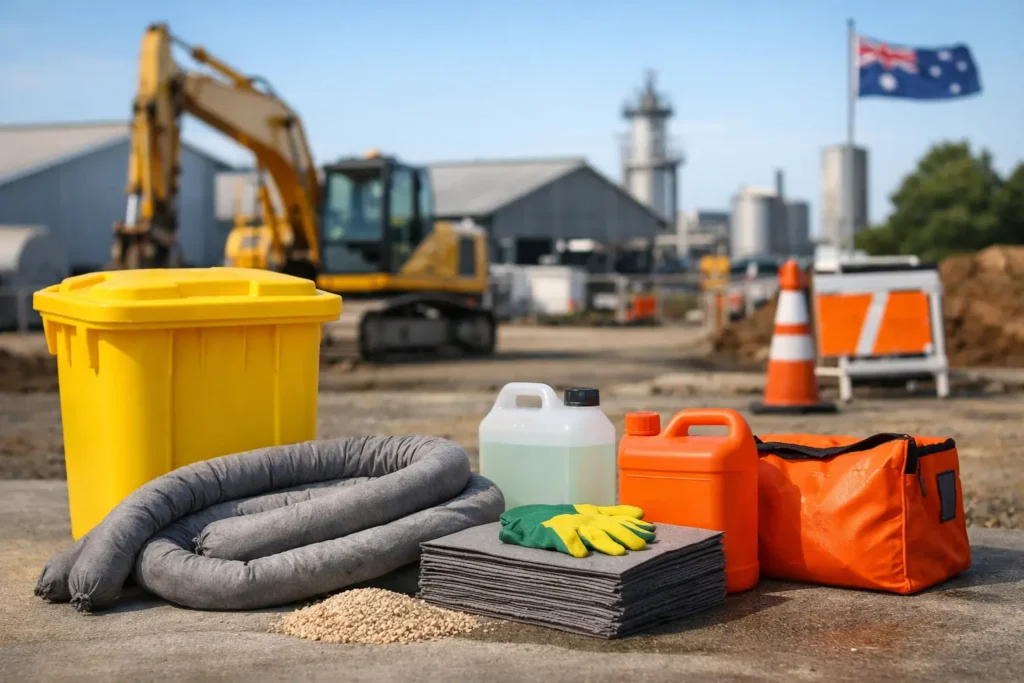
A ready-to-deploy kit should include absorbent pads, socks or booms, pillows for pooled liquid, personal protective equipment, disposal bags and ties, plus clear instructions. A scoop or scraper can also make recovery faster on rough concrete. For chemical kits, ensure the gloves and other protective equipment are suitable for the chemicals being handled.
Before ordering, check four operational details:
- The absorbent type matches the liquids your crew handles.
- The stated capacity is suitable for the credible spill, with practical allowance for containment.
- The container suits its storage position, whether that is a vehicle, workshop wall or outdoor loading area.
- Replacement pads, socks, bags and protective equipment can be held nearby for fast restocking.
Colour coding helps crews grab the right equipment under pressure, but it should not be your only control. Label each kit clearly with its intended use and include it in induction and toolbox talks. Staff do not need complex training to place socks, cover a drain and use pads, but they do need to know when to stop, isolate the area and escalate.
Keep kits ready after the first spill
The most common spill-kit failure is simple: the kit was used months ago and nobody replaced the contents. A half-empty bin can look ready from across the workshop, yet offer little support when a drum leaks.
Assign one person or shift team to inspect each kit on a regular schedule. Check that the container is accessible, absorbents are dry, instructions are readable and disposal supplies are present. Record the check alongside other safety equipment inspections. After any spill, replenish the used components straight away and review whether the kit capacity was enough.
Keep spare pads and socks near high-use areas so minor leaks do not empty a complete response kit. This protects your emergency stock and makes routine housekeeping quicker. It also gives supervisors a clear signal when a recurring leak needs maintenance attention rather than another pack of absorbents.
Select the right kit, place it where the spill starts and keep refills ready. That is what turns spill response from a last-minute scramble into normal, controlled site practice.