Blog
Hazchem Kit Selection for Faster Spill Response
Oct
A 20L bag is not a site spill solution when a 205L drum fails beside a stormwater drain. Effective hazchem kit selection starts with the credible worst-case spill on your site, then matches absorbent capacity, chemical compatibility and containment to that risk. Get this wrong and your crew loses time sorting unsuitable pads while product reaches drains, stock, traffic areas or neighbouring property.
For workshops, depots, warehouses, civil sites and government facilities, the buying decision is straightforward: select for the liquid you handle, size for the container that can fail, and position equipment where people can reach it immediately. Secure response capability before an incident exposes a compliance gap.
Start hazchem kit selection with the liquid
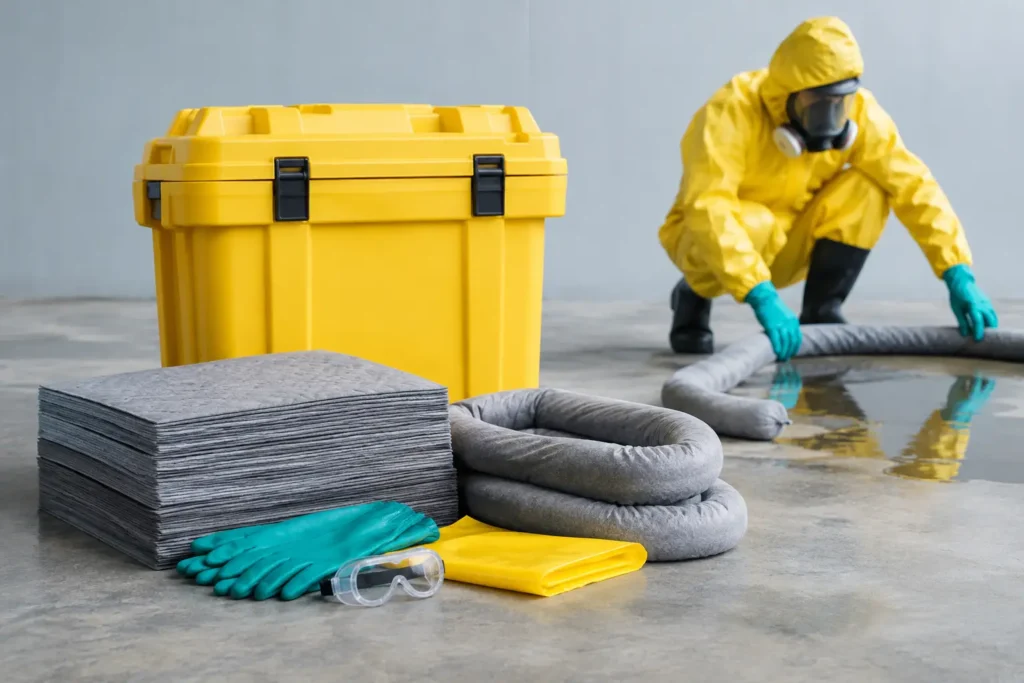
A chemical or hazchem spill kit is designed for hazardous liquids where an oil-only kit is not suitable. Chemical absorbents are commonly colour-coded yellow for fast recognition and are intended to deal with a broad range of aggressive liquids, including acids, alkalis, coolants, solvents and other hazardous chemicals. Always confirm the product compatibility against the safety data sheet (SDS) for the specific substance on site.
Do not substitute absorbent types because they look similar. Oil and fuel absorbents use hydrophobic polypropylene media: they repel water and selectively recover hydrocarbons from wet ground or water. They are the right operational choice for diesel, petrol, oils and hydraulic fluid, but not a default answer for corrosive chemical leaks. General-purpose absorbents suit many non-aggressive workshop liquids, yet may not provide the compatibility needed for acids or caustics.
If your operation stores or transfers chemicals in drums, decants product, maintains plant batteries, manages pool chemicals, treats water or handles laboratory and maintenance chemicals, deploy a dedicated chemical/hazchem kit at the point of use. The label, SDS and chemical register should drive the selection, not guesswork at the time of release.
Treat unknown liquids as a controlled hazard
Unknown spills need a cautious response. Isolate the area, stop the source only where safe, protect drains and use appropriate PPE before applying absorbents. If fumes, violent reaction potential or chemical identity creates uncertainty, escalate under your emergency procedures rather than sending staff in with a standard kit.
A spill kit supports a trained response. It does not replace chemical handling controls, eyewash arrangements, ventilation, PPE or emergency services where the risk exceeds your team’s capability.
Size the kit for the spill you could actually face
Capacity is where many sites underbuy. A kit should not be sized to the small drips normally seen on the workshop floor. It must handle the credible release from the largest container, hose, pump or vehicle system in that area, with enough material left to create a perimeter and protect drainage.
Use this practical guide when setting your site standard:
| Typical application | Practical kit capacity | Selection focus |
|---|---|---|
| Service ute, field technician or small plant | 20L to 30L | Compact bag or carry case for immediate first response |
| Forklift zone, maintenance bay or small store | 50L to 80L | Mobile kit for leaks from containers, machinery and batteries |
| Workshop, loading area or chemical cabinet zone | 120L to 120L+ | More pads, socks and disposal bags for a sustained response |
| Warehouse, depot, bulk storage or transfer point | 240L and above | Wheelie-bin format, drain protection and secondary containment |
A 240L wheelie-bin kit provides high visibility and carries enough absorbents for larger incidents, but it is not automatically the correct answer everywhere. A kit parked 80 metres from the risk is slower than a 50L unit positioned beside the chemical store. Build layers: place compact kits close to work, then back them up with larger site kits at accessible response points.
For vehicle fleets, equip each truck, ute and mobile plant unit according to the liquids it carries and the environments it enters. A vehicle kit needs to fit securely behind the driver’s seat or in the toolbox, remain intact under vibration and be simple enough for a driver to deploy under pressure.
Protect drains before you absorb the spill
The fastest way to turn a manageable spill into an environmental incident is to let it enter a stormwater drain. Absorbent socks should form a quick perimeter around the release, but they cannot always stop liquid travelling on sloped or uneven surfaces.
Position drain protection products near exposed grates, loading docks, wash bays, refuelling points and chemical transfer areas. Choose a surface drain cover for temporary emergency sealing or a correctly sized drain filter for installed catch-basin protection; these are different products and are not interchangeable. Where liquid is already moving, deploy socks upstream and downstream, then apply pads or particulate absorbent to recover pooled product.
For drum stores and transfer areas, spill kits are only one control. Spill bunds, drum pallets and IBC bunding provide secondary containment before a leak becomes a ground or drainage problem. Match bund capacity to the containers stored and the relevant site requirements. A collapsible bund may suit mobile maintenance work; a fixed pallet delivers day-to-day protection under drums and IBCs.
Check what is inside, not just the litre rating
Two kits with the same advertised capacity may not support the same response. The contents determine whether staff can contain, recover and dispose of a spill safely. For a chemical kit, look for compatible pads, absorbent socks, pillows for higher-volume pooling, PPE, disposal bags and clear instructions.
Your crew should be able to identify the kit at a glance, access it without a key or obstacle and know what each component is for. Pads lift liquid from a surface. Socks contain and channel it. Pillows deal with concentrated pooling or leaks beneath equipment. Disposal bags hold used absorbents for compliant waste handling.
Do not overlook PPE. The gloves, goggles and protective equipment supplied in a kit may be suitable for initial response, but PPE must match the chemicals present and the SDS requirements. If your hazard profile includes strong corrosives or solvents, assess whether additional site PPE is required alongside the kit.
Position kits where delays happen
Map the path a spill takes, not just the place liquid is stored. Consider receiving areas, forklift routes, decanting benches, workshop pits, wash bays, fuel points, battery charging zones and waste storage. A leaking drum can be controlled early at the pallet. Once it is moved through a warehouse aisle, the response becomes larger, slower and more disruptive.
Mount clear signage, keep access routes open and inspect kits on a scheduled basis. Replace used or degraded components immediately. A wheelie bin full of empty bags or a vehicle case missing its socks is not compliance equipment – it is a false assurance.
Maintain refills as a planned purchase, particularly across multi-site operations. Refill packs reduce the cost of restoring capability after a minor event and help procurement teams standardise contents across depots. Record inspections, usage and replacements so site managers can identify repeated leak points and prevent the next incident at the source.
Build purchasing around operational readiness
For procurement teams, standardisation removes uncertainty. Establish a simple matrix by location: oil and fuel kits for refuelling and fleet areas, chemical kits for hazchem handling points, general-purpose kits for ordinary maintenance zones, and vehicle kits for mobile crews. Add drain protection and secondary containment where spills could reach water or leave the controlled work area.
When ordering, confirm capacity, contents, chemical suitability, storage format and replenishment options. Specify delivery deadlines for shutdowns, project mobilisation or compliance audits. Spillkits.com.au supports purchase orders, provides itemised GST for products and freight, and offers rapid nationwide dispatch for buyers who need equipment on site without procurement friction.
Equip the area before the next drum is opened, the next vehicle is serviced or the next load is received. The right kit, in the right place, gives your crew a controlled first move when seconds matter.