
Blog
Spill Pallet Versus Spill Deck: Which Fits?
Aug
A leaking 205L drum can turn a tidy workshop bay or depot aisle into a slippery, costly clean-up within minutes. Choosing between a spill pallet versus spill deck before that happens gives your crew a defined containment point for oils, fuels and chemicals – without blocking access to the materials they use every day.
The right choice comes down to how much you store, how often staff need access, where the equipment sits, and the realistic spill volume you need to contain. A spill pallet is usually the better fit for drums, while a spill deck often suits low-profile storage, plant areas and spaces where frequent handling matters. Get the containment base right, then keep the matching absorbents and spill response equipment nearby.
Spill pallet versus spill deck: the practical difference
Both products provide secondary containment. They sit under containers that may leak, catch drips and spills, and help stop liquids reaching the floor, stormwater drains or surrounding work areas. Neither replaces good handling procedures, routine container checks or a ready-to-use spill kit.
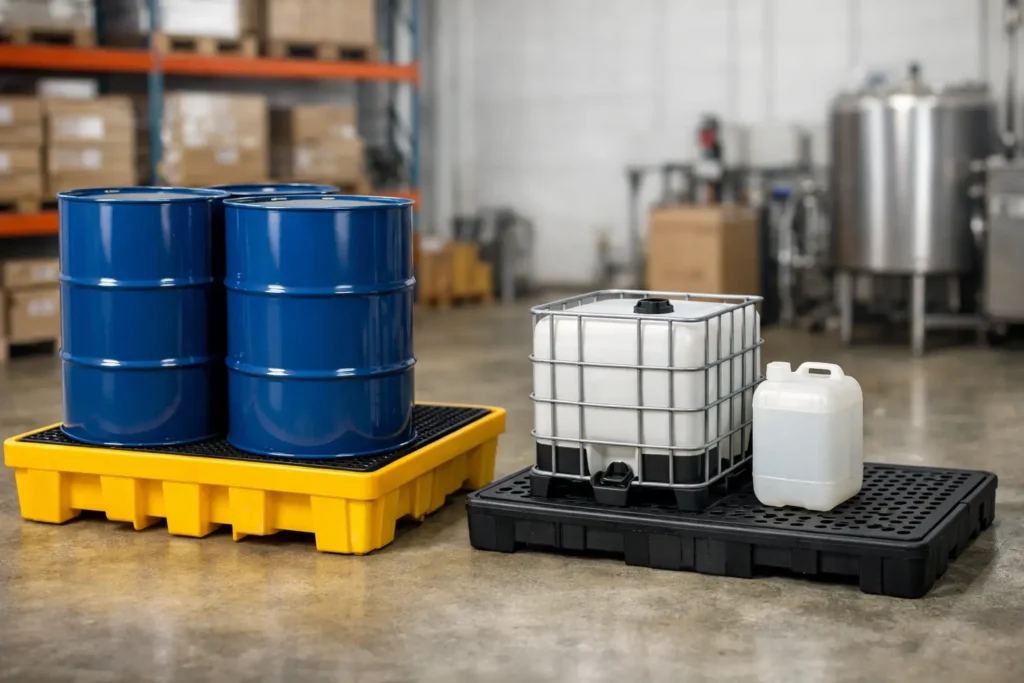
A spill pallet is generally a raised, moulded containment unit designed to hold drums, pails or smaller containers. It normally includes a removable grate so containers stay above any collected liquid. Many are built around standard drum configurations, such as one-drum, two-drum or four-drum capacity.
A spill deck is typically lower to the ground and modular. Individual deck sections can be connected to create a larger contained area, often with optional ramps for easier trolley, drum dolly or pallet-jack access. It is commonly used where the storage footprint may change, or where workers need to move containers on and off containment regularly.
The distinction matters operationally. A higher spill pallet may provide substantial sump capacity in a compact footprint, but lifting a full drum onto it can require a drum lifter, forklift or appropriate handling method. A low-profile deck reduces the step up, though it may take more floor area to achieve the same storage capacity.
When a spill pallet is the better choice
Choose a spill pallet where your main priority is storing drums securely in one defined location. It is a practical option for lubricant stores, chemical rooms, maintenance workshops, wash bays and warehouse holding areas where containers are not moved every shift.
A four-drum spill pallet is often suited to a workshop that keeps common fluids on hand: engine oil, hydraulic oil, coolant concentrate and waste oil. A single-drum unit can work well beneath a waste-oil drum, decanting point or small chemical container. The raised grate keeps the drum clear of any liquid collected in the sump, making it easier to spot a leak before it becomes a larger problem.
Best fit for stable drum storage
A spill pallet suits sites where drums are delivered, placed and used in position for long periods. It gives supervisors an easy visual check: if liquid is visible below the grate, investigate the source, isolate the container and clean it up promptly.
Look closely at the pallet’s stated sump capacity, load rating and chemical compatibility. Polyethylene units are widely used because they resist many oils, fuels and corrosive liquids, but compatibility is never automatic. Check the safety data sheet for the specific product being stored and confirm the bund material is suitable.
Also consider handling access. If your team uses a forklift to place full drums, allow room to approach safely without striking walls, racking or the containment unit. Do not treat a spill pallet as a forklift pallet unless it is specifically designed and rated for that use.
When a spill deck makes more sense
A spill deck earns its place where access and flexibility matter as much as containment. Its low profile can make daily drum movement less awkward, particularly in busy maintenance areas where technicians use hand trolleys, drum cradles or pallet jacks.
Modular decks are useful for changing storage layouts. Start with one section under a small fluid station, then add sections as the number of containers grows. This can be more practical than replacing a single containment unit when a fleet workshop expands or a depot changes its chemical storage arrangement.
Best fit for frequent access and changing layouts
Select a spill deck for low-level storage, regular decanting tasks or areas where a raised pallet would create an inconvenient lifting height. Add a compatible ramp if staff will move drums or containers across the edge. A ramp is not just a convenience – it helps reduce trips, jolts and the chance of a container falling during handling.
The trade-off is footprint. A deck that holds several drums can occupy more floor space than a compact raised pallet. In a narrow store room or between workshop bays, measure the area properly, including ramp clearance and safe pedestrian access. Keep emergency exits, fire equipment and electrical switchboards clear.
Compare capacity before you buy
The most common purchasing mistake is choosing containment based only on how many drums fit on top. Drum count is useful, but sump capacity is the figure that protects your site when a container fails.
Use this quick comparison when selecting equipment:
| Requirement | Spill pallet | Spill deck |
|---|---|---|
| Fixed drum storage | Strong choice | Suitable where low access is needed |
| Frequent drum movement | May need lifting equipment | Often easier with a ramp |
| Floor space | Usually compact | Can require more area |
| Layout flexibility | Fixed configuration | Modular sections can expand |
| Sump depth | Often deeper | Usually shallower per section |
| Best for | Drum stores and waste-fluid stations | Workshops, dispensing points and changing layouts |
Check your workplace procedures, site risk assessment and applicable environmental requirements when calculating capacity. As a practical baseline, plan for the largest credible container failure rather than a small drip. If you store a 205L drum, containment that only catches a few litres of seepage is not enough for a major puncture or failed bung.
Where multiple containers are stored together, assess the total quantity, the largest individual container and the likelihood that liquids could mix. This is particularly important for chemical storage. Some chemicals must not be stored together, even when each drum sits inside the same broad containment area.
Match the containment to the liquid
Oil and fuel storage commonly needs a different response plan from acids, alkalis or mixed industrial chemicals. The bund may physically hold the liquid, but your clean-up materials need to suit it too.
For diesel, petrol, hydraulic oil and lubricants, use oil and fuel absorbents that repel water and target hydrocarbons. This matters outdoors or near wash-down areas, where rainwater can otherwise add unnecessary waste volume. For acids, caustics and unknown liquids, chemical absorbents and suitable personal protective equipment are the safer starting point.
General purpose pads are useful for many non-aggressive workshop fluids, but they are not a universal answer. Train staff to identify the spill where possible, refer to the safety data sheet and avoid using unsuitable absorbents on hazardous chemicals.
Keep drain protection close to any containment area near stormwater. A spill pallet or deck only controls the liquid underneath its footprint. If a drum is knocked over beside it, the first priority is to stop the flow, protect nearby drains and deploy absorbents around the spill.
Set up your containment area properly
A spill pallet or spill deck performs best when it is positioned on a sound, level surface. Uneven concrete can reduce effective sump capacity and make drums unstable. Avoid placing containment over cracked flooring, directly in traffic lanes or where forklifts can clip containers during routine movements.
Label the storage area so workers know what belongs there. Keep incompatible materials separate, and inspect containers for damaged bungs, split seams, swollen sides and drips around taps. A simple weekly check can prevent a slow leak from filling the sump unnoticed.
Place a spill kit within easy reach, not in a locked office or at the far end of the warehouse. For a small drum store, a compact kit with pads, socks, disposal bags and PPE may be enough. Larger workshops, fuel areas and transport depots need greater absorbent capacity and clear instructions for escalation.
After any incident, restock immediately. Used pads and socks are no longer spill readiness – they are waste waiting to slow down your next response. Keep refill components on hand so the kit is ready for the next shift.
Buy for the way your crew actually works
Choose a spill pallet if you need dependable, high-capacity containment under drums that largely stay put. Choose a spill deck if your team needs low-profile access, modular coverage and easier movement around a working fluid station. In some larger facilities, the right answer is both: pallets in the drum store and decks at active dispensing or maintenance points.
Measure the space, count the containers, identify the liquid and plan for the biggest credible leak. Equip the area before the next delivery arrives, keep the right absorbents within reach, and give your crew a clean, obvious place to act the moment a leak starts.