Blog
Bulk Liquid Unloading Guide for Safer Sites
Oct
A bulk liquid unloading guide is not paperwork for the noticeboard. It is the plan that stops a hose failure, overfilled tank or missed coupling from becoming a contaminated drain, a stopped work area and an urgent clean-up bill. Whether you receive fuel, oils, chemicals, coolants or process liquids, secure the unloading zone before the delivery vehicle arrives.
For site supervisors, fleet managers and procurement teams, the objective is simple: contain the credible spill, protect stormwater and have the right response equipment within reach. Select equipment against the liquid type, transfer volume and worst-case failure point – not just the size of the delivery.
Bulk liquid unloading guide: start with the transfer risk
Every unloading task has three points where control can fail: the connection, the transfer path and the receiving vessel. A coupling can leak while being fitted, a hose can split or be driven over, and a tank can overflow because the available capacity was not confirmed. Your controls need to cover all three.
Start by identifying what is being unloaded and where it can travel. Hydrocarbons need oil-only absorbents that repel water. Acids, caustics and unknown hazardous liquids need chemical absorbents and appropriate PPE. Non-hazardous water-based liquids may suit general-purpose absorbents, but do not assume a product is harmless because it is common on site.
Then assess the physical layout. Is the unloading point beside a stormwater grate? Does the tanker reverse through the area? Is the ground sloped towards a drain, loading bay or neighbouring tenancy? A small release can travel well beyond the hose connection if the surface is hardstand and the drainage path is open.
Before each delivery, confirm the receiving tank has enough available volume. Do not rely on a gauge that has not been checked or a verbal estimate from the previous shift. Confirm the product, the destination tank, the transfer quantity and the designated operator. This takes minutes and prevents one of the most damaging avoidable failures: an overflow during an otherwise routine delivery.
Build containment around the realistic spill
Secondary containment must be positioned to capture a release at its source. For drums, IBCs and routine decanting stations, use bunded pallets or purpose-built bunding sized for the stored vessel and the liquid hazard. For temporary work, mobile and collapsible bunds create a contained work zone under pumps, hoses and fittings.
At an unloading point, containment may involve a combination of a drive-over bund, portable bunding and drain protection. The best choice depends on vehicle access, expected liquid volume and whether the operation is permanent or occasional. A low-profile bund may suit a depot where vehicles cross the area daily. A collapsible bund is often more practical for civil crews, remote sites and changing delivery locations.
Containment capacity is not an area to guess. Check your site obligations, the material safety data and relevant Australian requirements before ordering. As a practical purchasing rule, size equipment for the largest credible release from the connection or hose, while ensuring the stored liquid arrangement has appropriate secondary containment. A shallow tray may catch drips. It will not control a hose rupture.
Protect nearby drains before unloading begins. Drain covers, drain seals and absorbent socks are fast controls that prevent liquids entering stormwater. Keep them at the unloading point, not locked in a storeroom at the other end of the warehouse. If a drain is within the likely flow path, cover it before transfer starts where this is safe and practical.
Select spill response equipment by liquid and volume
The right spill kit lets the operator act immediately while the site escalates the incident. Match the kit to the liquid first, then choose capacity based on the volume you need to control before external support or a full clean-up can occur.
| Site situation | Recommended response equipment | Why it works |
|---|---|---|
| Diesel, petrol, hydraulic oil or lubricants | Oil and fuel spill kit with hydrophobic pads, socks and pillows | Absorbs hydrocarbons while repelling water, making it suitable around wet areas and drains |
| Acids, alkalis, solvents or unknown chemicals | Chemical or hazchem spill kit with compatible absorbents and PPE | Provides broader chemical suitability for hazardous liquid response |
| Coolant, water-based liquids and mixed workshop spills | General-purpose spill kit | Gives flexible absorbency for common non-aggressive liquids |
| Tanker unloading or bulk transfer point | Large mobile spill kit, drain covers and portable bunding | Supports rapid containment of a larger release across hardstand |
A 20L vehicle bag is useful behind the driver’s seat for small leaks and roadside response. It is not sufficient as the sole control for a bulk tanker delivery. For unloading areas, a 120L or 240L wheelie-bin format gives operators more absorbent capacity, easier site visibility and room for PPE, disposal bags and drain protection. The correct size depends on your risk assessment, but undersizing is a false economy when the spill reaches drainage.
Keep refill components on hand. Pads disappear during minor clean-ups, socks are deployed around leaks, and used PPE must be replaced. A kit that looks complete from a distance can be ineffective when its core absorbents have been used without being replenished. Make spill kit inspections part of pre-start checks and delivery-area housekeeping.
Set up the unloading zone before the tanker arrives
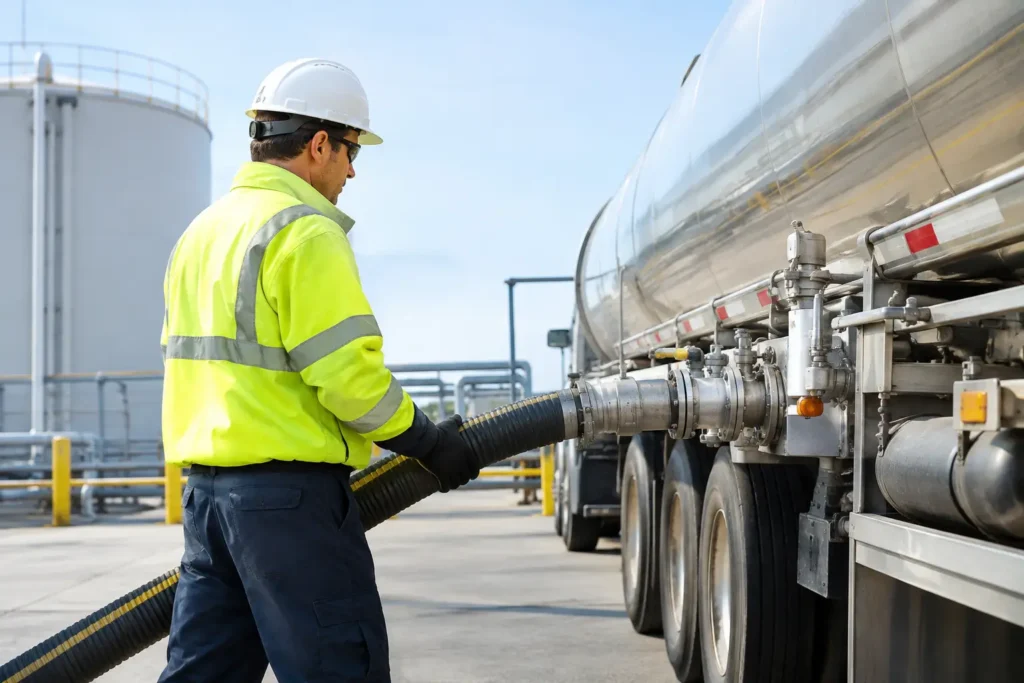
Mark the unloading area, remove unnecessary traffic and establish a clear exclusion zone. The driver and receiving operator should know the product, connection point, emergency shut-off process and communication method before hoses are opened. Where appropriate, use wheel chocks and ensure the vehicle is stable.
Inspect hoses, camlocks, gaskets, valves and fittings for wear or damage. Confirm caps are removed from the correct connections and place drip trays under likely leak points. Never force a damaged fitting into service to keep a delivery moving. A delayed transfer is cheaper than a release that closes a work area for the day.
Stage the response equipment in plain view. Position absorbent socks to direct liquid away from drains, have pads and pillows ready for collection, and ensure waste bags or recovery containers are available. If the liquid is flammable, remove ignition sources and confirm suitable fire controls are available. Store compatible flammables in approved cabinets away from the active transfer area where applicable.
During transfer, keep a trained person in attendance. Do not leave an unloading operation unattended to answer calls, receive stock or complete paperwork. Monitor the receiving tank level, hose route and connection points throughout the delivery. If conditions change – rain increases runoff risk, a vehicle enters the exclusion zone or a fitting starts weeping – stop the transfer and correct the control.
Respond fast when liquid escapes
The first action is to stop the source if it can be done safely. Close the valve, activate the emergency shut-off or stop the pump. Then protect people, isolate ignition sources where relevant and prevent the liquid entering drains or waterways.
For a manageable spill, place absorbent socks around the release and across the downhill path. Use pads for surface liquid and pillows for pooled volumes. Work from the outside inward so the spill does not spread under foot traffic or vehicle movement. Collect used absorbents into suitable disposal bags or containers, label waste as required and arrange disposal according to the liquid and local waste requirements.
Escalate immediately if the product is hazardous, the release is beyond site capacity, vapours are present, a drain has been affected or there is a threat to people or the environment. Do not turn a significant incident into a bigger one by relying on an undersized kit or untrained staff.
Make procurement part of operational readiness
Do not wait for a delivery incident to discover that your bund is too small or your spill kit has no pads left. Build an unloading-point equipment register covering portable containment, drain protection, spill kits, replacement absorbents, PPE and waste handling supplies. Record quantities, inspection dates and responsible people.
For multi-site operators, standardise equipment by risk profile. A workshop may need a general-purpose kit plus oil-only response equipment. A chemical dosing area needs a chemical kit and compatible containment. A fuel depot needs larger-capacity response equipment, visible drain protection and controls that suit vehicle movements. Standardisation makes replenishment faster and gives procurement teams clear item specifications.
Spillkits.com.au supports fast online ordering for commercial and government buyers, including purchase order acceptance, itemised GST for products and freight, and rapid nationwide dispatch. Equip your unloading areas before the next delivery, not after the next spill.
The most effective unloading control is the one already staged beside the hose: correctly sized, matched to the liquid and ready for the operator who has to act in the first minute.
Relevant products: Explore Oil & Fuel Mobile Spill Kit – 120L and Chemical Mobile Spill Kit – 240L to select equipment suitable for your site and the liquids involved.