Blog
Loading Bay Spill Response That Keeps Freight Moving
Sep
A leaking 205L drum, split pallet wrap or punctured IBC can turn a busy loading bay into a stop-work zone within minutes. Effective loading bay spill response prevents liquids reaching stormwater drains, keeps forklifts and trucks moving safely, and gives your crew clear equipment to deploy before a minor leak becomes an environmental incident.
For Australian depots, workshops, warehouses and government facilities, the answer is not one token spill kit mounted inside an office. Secure the loading area with spill equipment matched to the liquids handled, the largest credible spill volume, vehicle movements and nearby drains. Stock it where the incident will occur – at dock doors, dispatch lanes, chemical receiving points and fleet loading zones.
Why loading bays create high-consequence spills
Loading bays bring together liquid freight, forklift tynes, uneven surfaces, tight turning circles and exposed drainage. A container can be damaged during unloading, a hydraulic line can fail on a forklift, or rain can wash leaked oil directly towards a grated drain. The operational cost is immediate: isolate the area, halt freight movement, clean up the spill and investigate whether material has entered the stormwater system.
The compliance exposure can be more serious. Site operators remain responsible for controlling pollutants on their premises, while lease conditions, customer requirements, environmental obligations and internal emergency plans may all demand prompt containment. Your spill response equipment needs to support the controls documented in your risk assessment, chemical register and site procedures.
Do not treat every spill the same. Oil and fuel need hydrophobic absorbents that repel water and perform around wet docks. Coolant, detergents, paints and mixed workshop liquids generally need general purpose absorbents. Acids, alkalis and unknown hazardous liquids demand compatible chemical absorbents and appropriate PPE. Selecting the wrong media can slow containment and place responders at unnecessary risk.
Build a loading bay spill response station
A response station should allow a trained worker to isolate, contain and recover a spill without walking across the site looking for supplies. Position the main kit in a visible, unobstructed location, protect it from weather where necessary, and mark it clearly. A wheelie-bin format works well for larger dock areas because it carries substantial absorbent capacity and can be rolled directly to the incident.
For a compact dispatch bay or service counter, a 50L to 120L kit may be suitable when credible spills are small and additional stock is nearby. High-throughput freight docks handling drums, IBCs or multiple vehicle movements usually need 120L to 240L capacity, supported by containment equipment. A 20L vehicle bag belongs in a ute, delivery van or forklift service vehicle – it is not a substitute for a fixed-site kit.
Use the following guide to select a practical starting point. Final sizing should reflect your largest credible release, the substance involved and the time needed to obtain extra supplies.
| Loading area | Typical risk | Practical response equipment |
|---|---|---|
| Courier or small dispatch point | Leaking cartons, small oil or coolant leaks | 50L–100L general purpose kit, absorbent pads, drain cover |
| Workshop loading lane | Hydraulic oil, fuels, lubricants and coolant | 120L oil and fuel kit, general purpose kit, socks and drain protection |
| Drum and pallet receiving area | Damaged 20L containers or 205L drums | 120L–240L kit suited to contents, absorbent socks, overpack and bunding |
| IBC transfer or bulk freight dock | Larger chemical or liquid release | Chemical-specific kit, drain covers, containment bund, compatible PPE and recovery containers |
Keep heavy-duty spill kits close to the hazard, but do not stop there. The main kit must include enough pads, socks, disposal bags and PPE for the likely event. Where forklifts operate, choose a tough cabinet, bin or wall-mounted format that will not be buried behind incoming stock.
Protect drains before absorbing the spill
The first operational question is simple: where will the liquid travel? In most loading bays, the answer is towards a grated stormwater drain. Put drain protection within immediate reach of the kit, not locked in a maintenance cage on the other side of the facility.
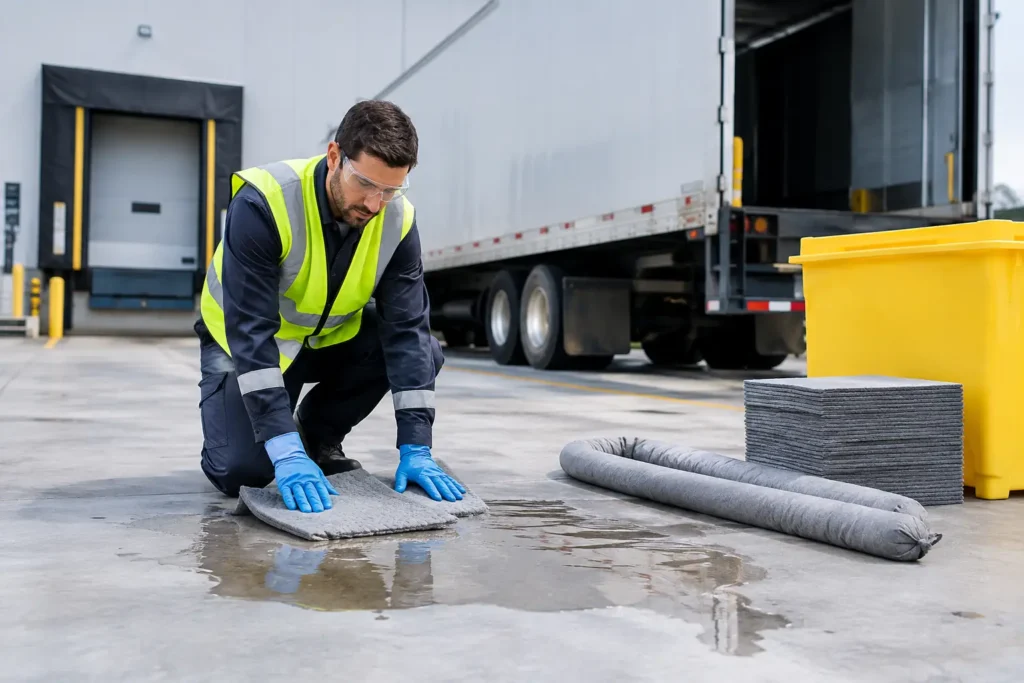
A flexible drain cover can provide fast temporary sealing over a clean, relatively flat drain surface. Drain mats, polyurethane covers and weighted covers each suit different drain shapes and surface conditions. Use absorbent socks to create a secondary barrier around the spill and across the slope. Then place pads or rolls inside the contained area to recover the liquid.
Drain covers are an emergency control, not a reason to overlook physical containment. If liquid transfer, drum storage or decanting happens routinely at the dock, install spill bunds or use portable containment beneath the activity. Collapsible bunding is particularly useful where delivery vehicles or pallets need to enter the area, but a permanent setup is not practical.
Select absorbents by liquid, not by convenience
A yellow or grey pad does not automatically make it suitable for every incident. Buying teams should standardise spill kit contents around the materials actually received and handled on site.
Oil and fuel absorbents are ideal for diesel, petrol, hydraulic oil and lubricants. Their hydrophobic polypropylene construction absorbs hydrocarbons while rejecting water, making them a strong choice for outdoor loading zones and wet weather response. General purpose absorbents suit many non-aggressive workshop liquids, including coolants, water-based oils and mild chemicals. Chemical or hazchem absorbents are designed for aggressive chemicals, but compatibility must still be checked against the substance and its safety data sheet.
Where unknown liquids are possible, the safest operational approach is to isolate the area, consult the SDS and escalate to competent personnel rather than assuming a standard general purpose kit is suitable. Keep appropriate gloves, goggles, disposable coveralls and face protection alongside the response equipment. PPE selection must match the chemical hazard, not the colour of the spill kit.
Contain the source and secure the stock
Absorbents manage the immediate leak. Secondary containment reduces the chance of repeat incidents while damaged stock waits for collection or assessment. Place leaking drums into suitable overpacks where appropriate, and move intact containers onto compliant containment systems rather than returning them to an unprotected floor.
For drum and IBC areas, select bunding based on container quantity, capacity and site requirements. Check relevant Australian Standards, environmental requirements and your organisation’s procedures when determining containment capacity. The practical objective is clear: contain a credible release without allowing it to escape the loading area or reach drainage.
If flammable liquids are held near the dock, do not leave them in temporary freight staging longer than necessary. Move stock into suitable flammable cabinets or approved storage arrangements, and keep ignition sources, forklifts and incompatible goods under control.
Make response equipment usable under pressure
A full kit is not a ready kit if staff cannot find it, open it or understand its contents. Assign a nominated person to inspect loading-bay equipment on a set schedule and after every use. Check seals, stock levels, PPE condition, drain-cover placement and access routes. Replace used absorbents immediately – a half-empty kit creates false confidence at the worst time.
Your loading bay procedure should make the first actions clear: stop the source if safe, protect drains, isolate vehicle and pedestrian traffic, contain the spill, recover the material, then arrange disposal according to the waste type and local requirements. Run short practical drills with forklift operators, dispatch workers and contractors. The best response plan is one your crew can carry out in the first five minutes.
For fleet operations, equip each vehicle with a compact kit sized for likely roadside leaks, then maintain larger response capacity at the depot. Vehicle bags should fit behind the driver’s seat or in the boot without being crushed by tools and freight. Refill packs make this economical, provided someone owns the task of checking every vehicle after use.
Order for uptime, not after an incident
Procurement should treat spill response stock as operational equipment, not discretionary consumables. Set minimum quantities for pads, socks, drain covers, disposal bags and replacement PPE. Keep refill components alongside the main kit so a response does not leave the dock unprotected for days.
Spillkits.com.au supports commercial and government purchasing with rapid nationwide dispatch, purchase order acceptance and itemised GST for products and freight. That gives procurement teams a cleaner path to replenish depleted kits, standardise equipment across multiple sites and document purchases for internal compliance records.
Secure your loading bay before the next delivery arrives. Place the right kit at the dock, protect every exposed drain, and match your containment capacity to the liquids moving through the site.
Related equipment: 120L Oil & Fuel Mobile Spill Kit.
Related equipment: 120L Oil & Fuel Mobile Spill Kit.