Blog
Transfer Pump Setup for Safer Drum Decanting
Sep
A transfer pump setup can turn a routine drum decant into a fast, controlled job — or create an immediate spill, fire and compliance problem. A loose hose, mismatched pump or unbunded 205L drum is all it takes to put product on the floor, into a drain or onto a worker. Set the system up once, size the containment correctly and keep response equipment within reach before any liquid moves.
Start with the liquid, not the pump
The pump must suit the liquid’s chemistry, viscosity, temperature and hazard classification. Selecting on flow rate alone is a common and expensive mistake. Diesel, waste oil, coolant, corrosive chemicals and flammable solvents each demand different wetted materials, seals and transfer controls.
For oils and fuels, a pump with compatible hoses and fittings is generally the practical choice, but every connection still needs inspection before use. For acids, alkalis or aggressive chemicals, verify compatibility across the pump body, seals, suction tube, hose, nozzle and container fittings. One incompatible gasket can fail under pressure and release product without warning.
Flammable liquids require additional controls. Use equipment suitable for the product and work area, eliminate ignition sources, and manage static electricity with correct bonding and earthing arrangements. Never assume a standard electric pump is suitable for solvent transfer. Check the product safety data sheet, site procedures and the equipment manufacturer’s specifications before deployment.
Transfer priorities by liquid type
| Liquid being transferred | Setup priority | Spill response stock to stage |
|---|---|---|
| Oil, diesel and hydraulic fluid | Hydrophobic absorbents, secure hose routing and closed nozzle | Oil and fuel absorbents, drain cover, 120L or larger kit |
| Coolant and general workshop liquids | Controlled flow and broad liquid compatibility | General-purpose pads, socks and waste bags |
| Acids, alkalis and hazardous chemicals | Chemical-resistant pump components and PPE | Chemical absorbents, compatible neutralisation where approved |
| Flammable solvents | Hazard-area suitability, bonding, earthing and ignition control | Chemical spill kit, drain protection and fire controls under site procedures |
Build the transfer pump setup around containment
A pump prevents manual handling strain. It does not prevent spills. Your primary defence is a stable, enclosed transfer path. Your secondary defence is containment sized to hold a release if the path fails.
Place drums and IBCs on suitable spill bunding before fitting a pump, opening a bung or connecting a hose. The containment must suit the number and capacity of containers stored or decanted, while allowing for operational space and any applicable site or regulatory requirements.
For a single 205L drum decant station, use a purpose-built drum bund or work floor that supports the loaded drum safely and captures a credible loss. For IBC transfer, choose an IBC bund or pallet with sufficient capacity and compatible construction. Collapsible bunds are useful for temporary civil, maintenance and mobile operations, but inspect them for punctures, folded edges and damaged support brackets before use.
Keep the delivery vessel inside the containment zone. A drum on a bund is not a controlled setup if the receiving container sits outside it and the nozzle can be knocked free. Where space allows, position both containers inside the bunded area or place the receiving vessel on its own suitable secondary containment.
Secure every connection before starting
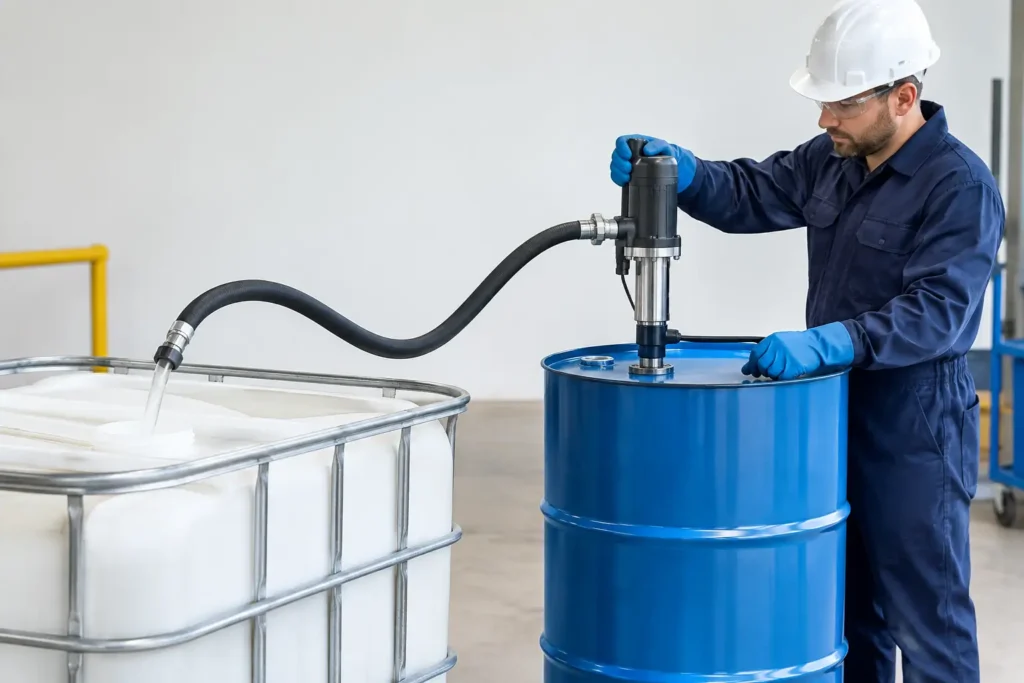
A dependable transfer system has no improvised fittings, kinked hoses or unsupported lines. Secure the pump to the drum or IBC as designed. Confirm the suction tube reaches the intended level, the discharge hose is rated for the liquid and pressure, and all couplings are correctly tightened.
Route hoses so forklifts, pallet jacks, tyres and foot traffic cannot crush them. Avoid running hoses across doorways, traffic lanes or drains. If the transfer must occur in an active area, barricade the work zone and assign an operator to the pump. Never leave a powered transfer unattended.
Before opening the nozzle, conduct a practical pre-start check:
- Inspect the drum, IBC, valve, pump body, hose and fittings for damage or leaks.
- Check available capacity in the receiving container.
- Confirm valves are correctly positioned and the nozzle can be positively shut off.
- Stage drain protection, absorbents and waste bags beside the transfer point.
- Put on PPE specified for the product and task.
For flammable liquids, add bonding and earthing checks. Do not rely on incidental contact through fittings or flooring as proof of electrical continuity.
Select spill equipment for the likely failure
Your response equipment must match the liquid and the volume at risk. A few pads on a shelf will not control a hose failure during a 205L drum transfer. Stock containment first, then absorbency, then disposal supplies.
Use absorbent socks to form a barrier around the bund edge, nearby drains or likely flow paths. Pads and rolls handle thin surface films and final clean-up. Pillows handle pooling liquid at the source. For oil and fuel, hydrophobic polypropylene media repels water while absorbing hydrocarbons. For chemicals, use compatible chemical absorbents.
Drain covers should be close enough to deploy in seconds. Keep a correctly sized cover, socks and a suitable spill kit at each permanent transfer station. For mobile plant and field crews, carry a compact vehicle kit matched to the liquids transported.
Replace used pads, damaged socks, full waste bags, gloves and drain covers immediately. A depleted kit is not a compliance asset.
Size the station for real operations
Build the transfer area around the largest routine job. If operators regularly decant 205L drums, design for 205L drums. If the site receives IBCs, do not force IBC transfer onto an undersized drum pallet.
Consider how containers arrive and leave the station. Forklift tines need clearance. Drum lifters need a stable approach. Operators need room to read labels, hold a nozzle safely and access the emergency shut-off.
For higher-volume depots and workshops, separate clean product storage from waste-liquid transfer. Clearly label pumps, hoses and nozzles by service.
Keep procurement simple and site-ready
Order pump accessories, bunding, absorbents and response equipment as one operational package. Procurement teams can set a site standard by specifying pump compatibility, container capacity, bund type, spill kit size and refill quantities.
For multi-site operators, standardise a 20L vehicle response kit for fleet units, a 120L or 240L kit for workshops and depots, and dedicated drain protection at transfer points.
Spillkits.com.au supports purchase order purchasing, itemised GST and rapid nationwide dispatch. Equip the transfer area before the next delivery arrives, then inspect it as routinely as the pump itself.
Related equipment: 2 Drum Spill Pallet Bund.