Blog
How to Contain Coolant Spills in Workshops
Sep
A split radiator hose, failed water pump or careless coolant transfer can put litres of contaminated liquid across a workshop floor in minutes. Knowing how to contain coolant spills immediately keeps slippery floors, stormwater drains, staff exposure and costly downtime under control. The right response is not to hose it away. Isolate the source, protect the drain and deploy the correct absorbents before the spill spreads.
Coolant incidents are common across vehicle workshops, transport depots, plant hire yards, council fleets and maintenance facilities. They are also highly preventable when crews have accessible spill equipment, clear instructions and enough secondary containment around stored liquids.
Why coolant spills need a fast response
Engine coolant is often treated as harmless because it looks like coloured water. That is a costly mistake. Many coolant products contain ethylene glycol, which can be harmful if swallowed and may attract animals because of its sweet taste. Even lower-toxicity propylene glycol formulations can carry corrosion inhibitors, dyes and contaminants that should not enter soil, drains or waterways.
On a busy floor, coolant creates an immediate slip risk. In a depot or workshop with floor drainage, the spill can become an environmental incident before anyone reaches the spill kit. Once liquid reaches a drain, the clean-up scope, reporting obligations and operational disruption can escalate quickly.
Treat every coolant release as a contained-liquid response. Check the product safety data sheet, follow your site emergency procedures and keep contaminated absorbents separated for appropriate disposal. Do not assume that dilution with water makes the problem disappear.
Contain coolant spills in the right order
The first few minutes determine whether a spill stays local or reaches your drainage system. Give operators a simple sequence they can follow under pressure.
1. Stop the leak safely
Secure the vehicle, machine, drum or container where safe to do so. Shut off transfer pumps, upright a fallen container and isolate the damaged hose or fitting. Do not place hands near hot engines, pressurised cooling systems or moving equipment.
If the leak cannot be stopped straight away, position a drip tray, portable bund or absorbent socks beneath the source. This buys time while preventing more liquid from spreading across the work area.
2. Protect drains before absorbing the bulk liquid
Your nearest drain is the priority. Place a non-adhesive drain cover over the grate, or build a barrier around it with absorbent socks. For larger spills or uneven surfaces, use multiple socks to direct liquid away from drainage points and towards a controlled collection area.
Drain protection must be stored where crews can reach it without crossing the spill. A drain cover locked in a remote storeroom is not an emergency response tool. Position drain protection near wash bays, service pits, liquid stores, loading areas and workshop exits.
3. Build a containment line
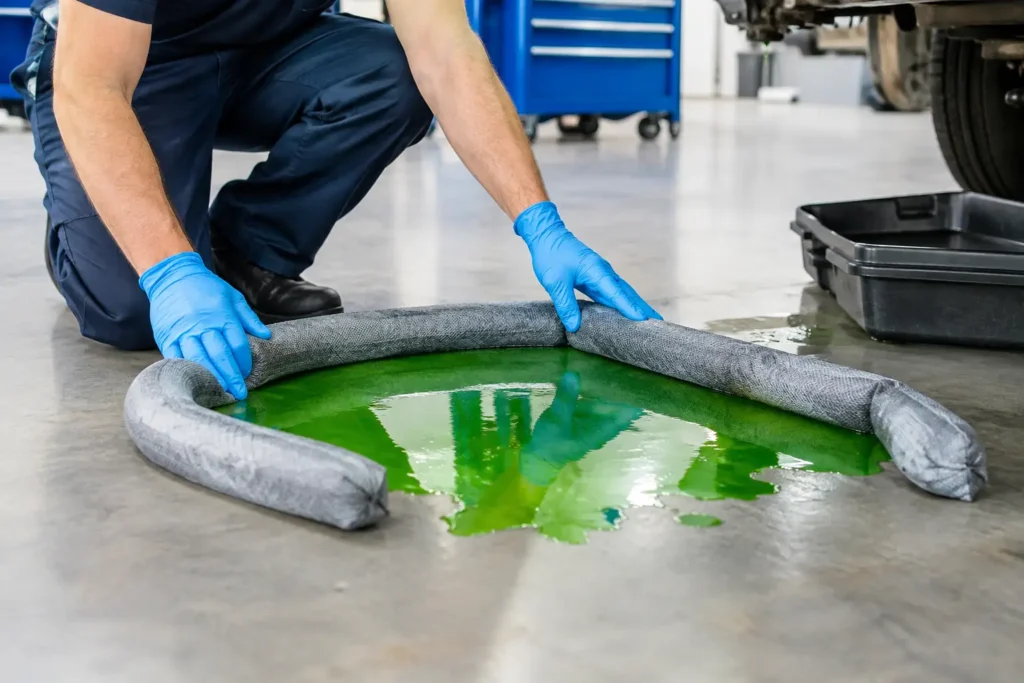
Use absorbent socks, booms or compatible temporary bunding to stop the spill footprint expanding. Start at the lowest point or the direction the liquid is travelling, then work back towards the source. For outdoor areas, account for rain, gradients and vehicle movement.
For recurring maintenance work, a collapsible spill bund provides more control than loose absorbents alone. It creates a defined capture zone under vehicles, plant and drums, particularly where a repair may involve draining coolant or removing components.
4. Absorb and collect the coolant
Once the spill is contained, lay pads over the liquid and add particulate absorbent where needed. General-purpose polypropylene absorbents are commonly suitable for coolant, water-based liquids and mixed workshop fluids. They absorb quickly, are easy to deploy and keep the clean-up controlled.
Work from the outside edge towards the middle. This avoids pushing liquid into clean areas. Use a scoop, shovel or scraper to collect saturated material, then place it in a compatible waste bag, drum or lidded container. Keep used absorbents labelled and arrange disposal in line with the coolant SDS and local waste requirements.
5. Inspect, clean and restock
Check under benches, around hoists, inside service pits and along floor joints. Coolant can travel farther than expected, particularly on smooth sealed concrete. Remove the drain cover only after you confirm no liquid has entered the drain.
Restock every item used before the next shift. A spill kit with empty pad sleeves and no drain cover creates false confidence, not compliance. Make replenishment part of the incident close-out process.
Select the right coolant spill equipment
The correct equipment depends on where coolant is stored, the largest credible release and how quickly your crew can access supplies. A small vehicle service bay needs a different response setup from a heavy-vehicle depot with bulk coolant drums.
| Work area | Typical coolant risk | Practical response equipment |
|---|---|---|
| Mobile mechanic or service ute | Small hose, radiator or container leak | 20L to 30L vehicle spill kit, pads, disposal bags and gloves |
| Light vehicle workshop | Drain-downs, cracked hoses and coolant transfers | 50L to 120L general-purpose spill kit, drain cover and absorbent socks |
| Fleet depot or heavy workshop | Larger cooling systems and multiple service bays | 120L to 240L wheelie bin spill kit, drain protection and portable bunding |
| Bulk liquid store | Leaking 205L drums, IBC valves or transfer failures | Drum or IBC bunding, large spill kit, drain covers and refill absorbents |
For most workshops, a general-purpose spill kit is the practical first choice for coolant because it can also respond to water-based liquids, oils and many everyday maintenance spills. However, coolant may be mixed with other products during a breakdown or clean-up. If acids, solvents, battery chemicals or unknown liquids are involved, isolate the area and select chemical-compatible response equipment instead of relying on a standard general-purpose kit.
Do not size a kit around the average drip. Size it around the largest realistic loss before staff can stop the source. A 20L vehicle bag is useful behind the driver’s seat, but it is not sufficient protection for a workshop draining heavy equipment or a depot storing multiple coolant drums.
Secondary containment prevents repeat incidents
Absorbents are for response. Bunding is for prevention. If coolant drums, containers or transfer stations are sitting directly on the floor, every handling error becomes a race to protect the nearest drain.
Use drum bunds for 205L coolant drums, IBC bunding for bulk containers and spill pallets beneath regularly stored liquids. Secondary containment captures slow valve leaks, damaged packaging and decanting spills before they reach the floor. It also gives your team a defined, cleaner storage area and makes inspections faster.
Capacity matters. Select bunding that accommodates the stored container volume and your site’s applicable storage, environmental and workplace requirements. Check the containment volume, chemical compatibility, loading capacity and access requirements before ordering. A bund that cannot safely support your drums or allow practical dispensing will be ignored by operators.
For temporary work, collapsible bunds are especially useful. Position one beneath plant during servicing, under leaking machinery awaiting repair or around a coolant transfer point. Deploy it before opening the system, not after liquid is already running across the floor.
Keep drain protection visible and ready
Drain covers, plugs and absorbent socks are low-cost equipment with high consequences. A single drain cover can prevent a workshop spill becoming a stormwater contamination event. Keep one within immediate reach of every high-risk drain, with enough socks to create a barrier if the liquid is already moving.
Train crews to identify where each drain leads. Not every grate serves the same system. Some discharge to trade waste, some to stormwater and some may connect to internal treatment equipment. Your site plan should identify drainage points, isolation controls and the response equipment assigned to each zone.
Build a response setup your crew will actually use
The best spill equipment is visible, clearly labelled and sized for the job. Place kits near service bays, liquid stores, wash areas, loading zones and fleet parking areas. Keep vehicle kits in utes, service vans and field maintenance trucks where a radiator or hydraulic failure can occur away from base.
Every coolant response station should include compatible absorbent pads, socks, waste bags, gloves, goggles and clear drain protection. Add refill stock nearby so the kit can be restored immediately after use. If staff must submit a long request or wait weeks for replacements, depleted kits will remain on the floor.
Spillkits.com.au supports fast procurement with rapid nationwide dispatch, itemised GST for products and freight, and purchase order options for commercial and government buyers. Equip your fleet and workshop with the containment capacity your operation actually needs, not the smallest kit that happens to be available.
A coolant spill should end with a clean, controlled work area and a fully restocked response point. Put the right kit beside the risk, protect the drain first and make secondary containment standard wherever coolant is stored or transferred.
Related equipment: General Purpose Absorbent Pads.