Blog
Forklift Leak Protection Options for Busy Sites
Sep
A forklift that leaves a small hydraulic oil trail across a warehouse floor is not a minor housekeeping issue. It is a slip hazard, a drain contamination risk and a clear sign that your site needs the right forklift leak protection options in place before the next hose, seal or fitting fails. Secure containment at the point of risk, then equip operators to respond without stopping the shift.
For workshops, depots, factories and civil fleets, the right answer is rarely one product. A practical system combines under-machine containment, drain protection and absorbents that match the fluid involved. Select the equipment around where forklifts park, charge, undergo maintenance and travel – not just around the spill kit cupboard.
Start With the Leak Location and Fluid Type
Hydraulic oil, transmission fluid, coolant, battery electrolyte and diesel each require a different response. Oil leaks are common around mast cylinders, hoses, steering components and fittings. These fluids can spread quickly under racking or towards a doorway, where rainfall can carry contamination into stormwater.
For mineral oils and fuels, use hydrophobic polypropylene absorbents. They repel water while lifting hydrocarbons, making them the sensible choice near loading areas, external hardstands and wash bays. General-purpose absorbents suit mixed workshop fluids where water-based liquids are also likely. Do not use oil-only media to manage corrosive battery acid or unidentified chemicals. Isolate the area and deploy the correct chemical-rated response equipment instead.
Battery charging zones deserve separate planning. A leaking lead-acid battery may require neutralising material and chemical absorbents, while lithium-ion battery incidents need site-specific emergency procedures beyond a standard oil spill response. Keep these risks separate in your purchasing plan.
Forklift Leak Protection Options That Work Together
A forklift leak can begin as a drip and become a mobile spill once the unit moves. Build layered protection so the first drop is captured, drainage points are defended and crews can contain a larger release immediately.
Drip trays and low-profile containment
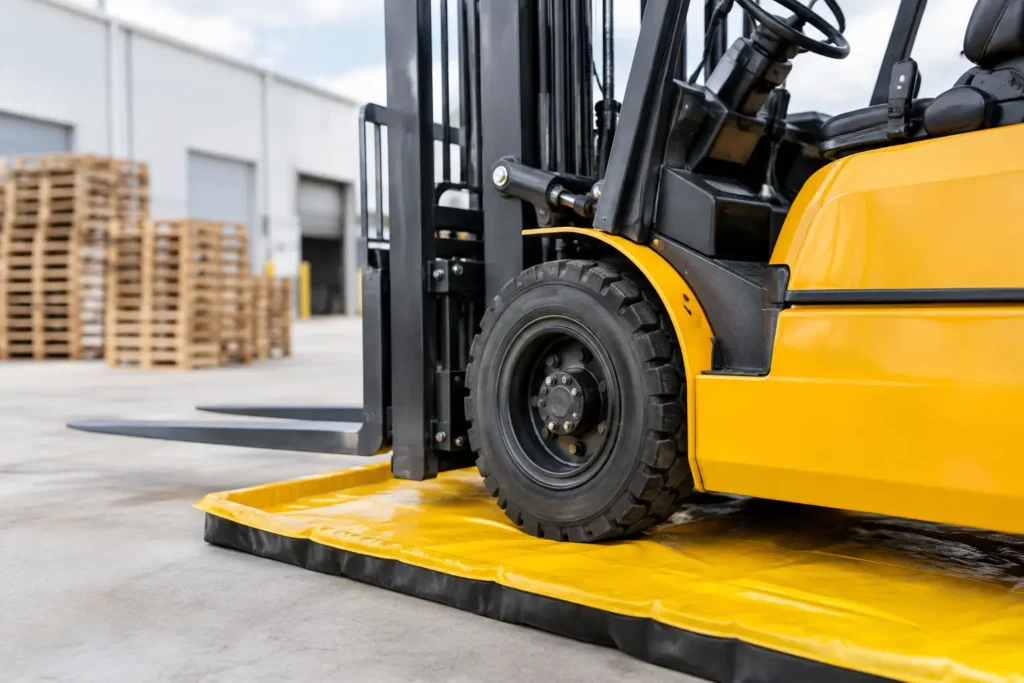
Place a drip tray or low-profile bund beneath forklifts that are awaiting repair, parked overnight or held in a maintenance bay. This is the first line of defence for persistent hose seepage and leaking cylinders. Choose a footprint that covers the likely drip zone without creating a trip point or interfering with safe access.
For a single electric or LPG forklift, a compact tray may be enough for short-term isolation. For diesel forklifts, larger plant or units with an active hydraulic failure, step up to a heavy-duty bund with enough capacity to hold the expected release. Do not guess based on the amount currently on the floor. Consider the oil held in the failed line, reservoir and damaged component, plus rain exposure if the equipment is stored outside.
Collapsible bunds are useful for mobile maintenance crews and temporary repair areas. They can be deployed around a forklift before work starts, then packed down once the repair is complete. They are not a substitute for fixing the leak, but they prevent contaminated washdown and costly floor remediation while parts are being sourced.
Absorbent pads, rolls and socks
Absorbents turn a contained leak into a controlled cleanup. Pads are ideal for small drips under a machine, while rolls cover a wider floor area along travel paths or service bays. Stock enough material to replace saturated pads promptly. Leaving soaked pads beneath a forklift only delays the problem and can spread oil when tyres pass over them.
Use absorbent socks to ring a leaking unit, block a doorway or direct fluid away from drains. Their value is speed: an operator can stop migration within minutes while the supervisor arranges repairs and waste disposal. Keep socks close to high-risk zones, not locked in an office or stored at the far end of the depot.
For sites handling several forklifts, hold both oil-only and general-purpose media. Clear labels matter. During a busy shift, crews must be able to identify the correct absorbent without reading a lengthy procedure.
Drain covers and drain protection
Stormwater drains are the point where a manageable workshop leak becomes an environmental incident. Put drain covers within immediate reach of workshop exits, loading docks, refuelling points and outdoor parking areas. A flexible cover can seal a clean, smooth drain quickly while a spill is contained with socks and pads.
Drain covers are emergency controls, not permanent drainage solutions. Inspect them after use, clean them as required and store them flat so they remain ready. If a forklift routinely parks near a drain, relocate the parking bay or install appropriate secondary containment rather than relying on a cover every day.
Spill kits sized for the task
A spill kit provides the response layer when a tray or bund is exceeded. Select capacity based on the largest credible release, the number of forklifts on site and the travel distance to the nearest drain. A small vehicle bag can support a service ute or mobile technician, but it will not manage a major hydraulic spill in a distribution centre.
Use this practical sizing guide when ordering:
| Operating area | Practical starting point | Best use |
|---|---|---|
| Service ute or field technician | 20L to 30L vehicle kit | Minor hose drips and roadside response |
| Small workshop with one or two forklifts | 50L to 80L spill kit | Day-to-day leaks and localised floor spills |
| Warehouse, fleet depot or loading area | 120L to 240L wheelie bin kit | Larger hydraulic failures and multiple responders |
| Outdoor plant yard or high-risk fuel area | 240L plus drain protection and bunding | Rapid control before contamination reaches stormwater |
Capacity is not the only factor. Check that the kit contains enough socks to contain the perimeter, enough pads for recovery, disposal bags, PPE and clear instructions. Refill used components immediately. A half-empty spill kit is a compliance gap disguised as a container.
Match Containment to Site Compliance Duties
Australian workplaces must manage spills that can harm people, property and the environment. Your exact obligations depend on the fluid, site activities, local authority requirements and relevant standards, including storage and dangerous goods controls where applicable. Do not treat a generic kit as proof that every risk is covered.
Document where forklifts are parked, maintained and charged. Record nearby drains, identify the maximum likely loss of hydraulic fluid and inspect the condition of trays, bunds and spill kits. This gives safety teams, procurement officers and government facility managers a defensible basis for equipment selection.
Secondary containment should be sized for the real equipment and task. A shallow tray may control normal drips, while a repair bay needs greater capacity for a failed hose or component removal. Where drums of oil, coolant or chemicals are used to service forklifts, contain those containers separately in suitable bunding. Prevent the source spill as well as the leak from the machine.
Set Up a Fast Response Zone
Place protection where people can reach it in seconds. A well-equipped forklift zone usually includes a labelled spill kit, oil-only pads and socks, a drain cover, a drip tray or bund, PPE and waste bags. Mark the location on site maps and include it in inductions for operators, maintenance contractors and cleaners.
Train crews on a simple sequence: stop the forklift safely, isolate the leak, protect drains, contain the spread, recover the liquid and report the incident. If fluid is unknown, smoking, reacting or entering drainage, escalate immediately under your emergency process. Fast action is useful only when it is safe action.
Inspection frequency should match usage. High-traffic depots may need weekly checks of spill stations and containment equipment, while a smaller workshop may include them in a scheduled monthly inspection. Check for saturated pads, damaged drain covers, missing PPE and containers that have been moved away from the hazard area.
Order for the Next Failure, Not the Last One
Avoid buying only enough equipment to replace what was used in the previous small spill. The next incident may involve a ruptured hose during peak dispatch, rainwater near a loading dock or a forklift stopping directly over a drain. Build reserve capacity into your order and keep refill stock on hand.
For procurement teams, simplify repeat ordering by standardising a spill response pack for each forklift area. Record the kit capacity, absorbent type, tray dimensions and refill components against each site. This reduces guesswork when a supervisor needs stock urgently and supports consistent purchasing across multiple locations.
Spillkits.com.au supports purchase orders, itemised GST for products and freight, and rapid nationwide dispatch for commercial and government buyers. Select the right containment capacity, replenish used absorbents and position drain protection before the next forklift leak tests your site controls. Equip your fleet now, so a failed fitting stays a contained maintenance job rather than an operational shutdown.
Related equipment: Heavy Duty Oil & Fuel Absorbent Pads and Collapsible Bund 2m x 2m.